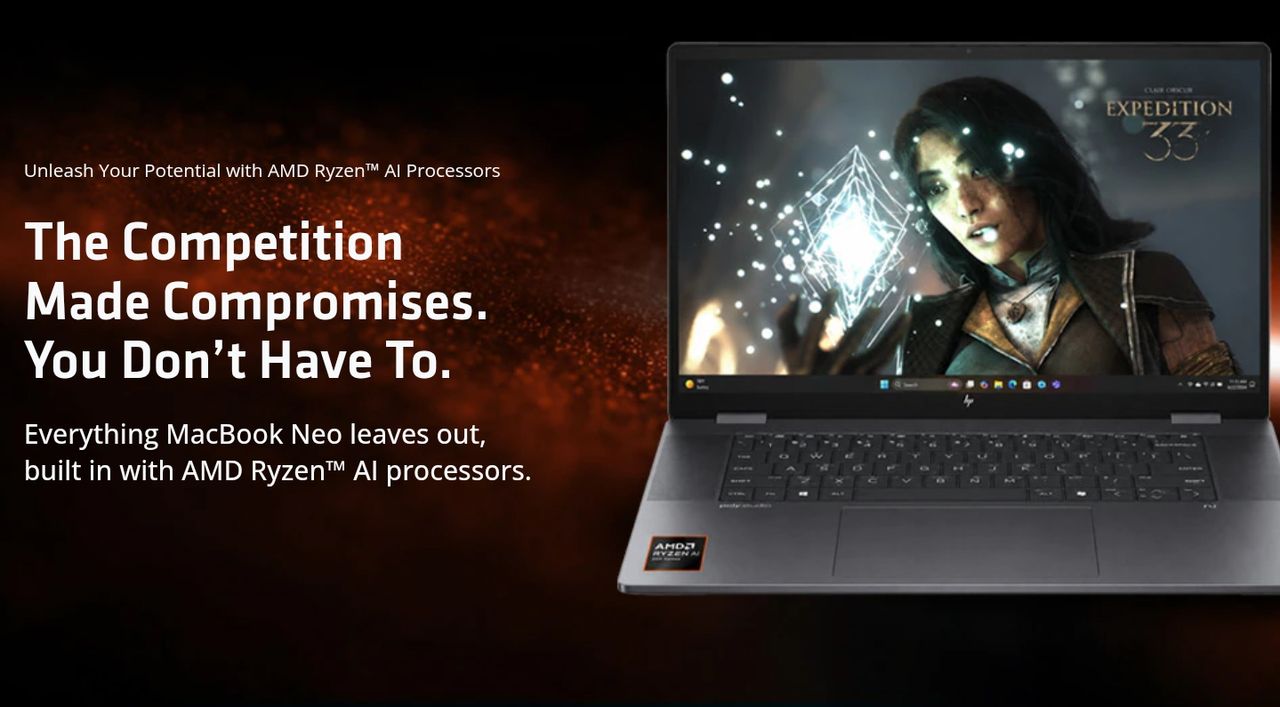
AMD's Challenge to Apple's MacBook Neo
The technology landscape is often enlivened by direct comparisons between major industry players. Recently, AMD issued a challenge to Apple's MacBook Neo, questioning its capabilities in the gaming sector. The Sunnyvale-based company highlighted how Apple's device struggles to handle a significant portion of the most popular titles in the PC gaming world, a market segment that demands high graphics and computing performance.
According to reports, the MacBook Neo was only able to run 5 out of the 20 top PC games considered, representing just 25% of the total. In contrast, AMD's offerings, described as more budget-friendly solutions, demonstrated the ability to run all 20 titles without issues. This performance disparity, while specific to the gaming sector, offers insights into hardware architectures and their suitability for intensive workloads.
Hardware Architectures and Specific Workloads
The comparison between AMD and Apple, though focused on gaming, underscores a fundamental principle in the hardware world: the importance of optimization for specific workloads. System performance depends not only on raw power but also on its architecture and its ability to efficiently handle the demands of particular software. In the case of games, this translates into high requirements for the GPU, VRAM, and memory bandwidth, in addition to a powerful CPU.
AMD's 'budget' solutions, often equipped with discrete GPUs featuring architectures optimized for graphics rendering and parallel computing, can offer higher throughput for gaming workloads compared to configurations that might prioritize other aspects, such as energy efficiency or integration into a closed ecosystem. This scenario highlights how hardware selection must be guided by the specific needs of the final application, a concept that resonates fully in the context of Large Language Model (LLM) deployments.
Implications for On-Premise LLM Deployments
For CTOs, DevOps leads, and infrastructure architects evaluating on-premise LLM implementations, the lesson from the AMD-Apple comparison is clear: hardware selection is critical and must be aligned with the AI workload requirements. An architecture that excels in one area (such as productivity or energy efficiency) may not be the most suitable for LLM inference or training, which demand specific parallel computing capabilities, large amounts of VRAM, and high throughput.
Evaluating the Total Cost of Ownership (TCO) for on-premise LLM deployments cannot ignore a thorough analysis of hardware performance. Investing in solutions not optimized for AI can lead to inefficiencies, high latency, and a higher TCO in the long run, due to the need to scale horizontally with multiple less performant units. Data sovereignty and compliance, often key motivations for self-hosting, require that the infrastructure is not only secure but also efficient in handling the most demanding AI workloads.
Future Prospects and Strategic Hardware Choice
The debate on hardware performance, like the one initiated by AMD, serves as a reminder that there is no single 'best' universal solution. Instead, there are solutions better suited to specific contexts and workloads. For companies operating in the field of artificial intelligence, and particularly in managing LLMs, understanding the capabilities and limitations of different silicon architectures is crucial for making informed strategic decisions.
Whether it's gaming or LLM inference, a system's ability to process large volumes of data with low latency and high throughput is a determining factor. The choice among different hardware options, be they dedicated GPUs, specific accelerators, or bare metal configurations, must be guided by a detailed analysis of application requirements, budget constraints, and performance objectives. AI-RADAR offers analytical frameworks on /llm-onpremise to evaluate these trade-offs, supporting deployment decisions that prioritize control, data sovereignty, and TCO.





💬 Comments (0)
🔒 Log in or register to comment on articles.
No comments yet. Be the first to comment!