The Signal Beyond the Raw Number: Context, VRAM, and Operational Stability
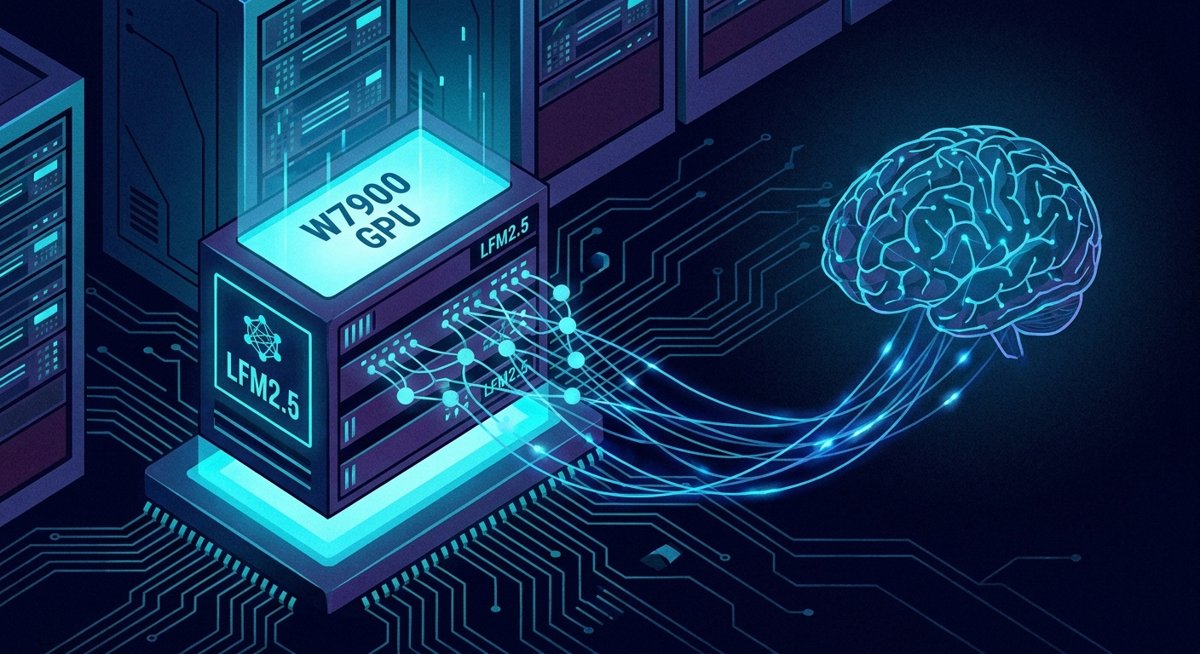
The test of LFM2.5-24-A2B on an AMD W7900 produces a number that, on its own, says little: around 95 tokens per second. The interesting part is the set of conditions behind that result. In Q8 form, the model occupies roughly 30 GB of VRAM and handles a 128,000-token context window. On a single professional card, this combination shifts the boundary of what a team can run locally without clusters or cloud services. Peak speed is not the key; the fact that it arrives alongside extended context and a stability profile suited to mechanical and recursive tasks is what matters.
For teams designing on-premise stacks, a 128,000-token context opens concrete scenarios: analyzing large codebases, reviewing long documents, processing logs or transcripts without breaking text into chunks that lose references. The cost is measured in VRAM, which grows with context length and quantization precision. Choosing Q8 over a lighter Q4 indicates a preference for numerical representation quality despite the larger footprint. At 30 GB, a single W7900 is sufficient; on cards with less video memory, the same setup would require compromises.
The stability described by the user is often overlooked in early evaluations. Many models show good numbers on short prompts but degrade in long sessions, repeated calls, or agent pipelines. LFM2.5-24-A2B is called a 'workhorse' for mechanical and recursive tasks, and that has precise operational value: fewer interruptions, fewer errors to manage, less human supervision on repetitive activities. In enterprise batch workloads that can run for hours, predictable behavior matters as much as tokens per second.
The third-order effect concerns workload classification. When a 24-billion-parameter model proves reliable for procedural tasks, a portion of flows currently running on larger models or cloud APIs can move to local hardware. This does not eliminate high-end models, but reduces the calls they must absorb, freeing resources and lowering operating costs. The result is an architecture where on-premise does not replace everything, but absorbs the repetitive and sensitive share of work.
AMD and ROCm: A Second Path for Local Inference
The test on a W7900 with llama.cpp and ROCm acceleration goes beyond a single model. For years, local LLM inference was tied to CUDA and NVIDIA GPUs. Seeing an AMD card run a 24-billion-parameter model with extended context and sustained speed shows the landscape widening. This is not episodic compatibility: llama.cpp is an open-source runtime with active support for multiple backends, and ROCm has accumulated improvements that make AMD hardware increasingly practical for inference.
This broadening has direct implications for Total Cost of Ownership. Organizations evaluating local infrastructure can compare configurations with different VRAM capacities without being locked to a single silicon supplier. A professional card with 32 GB of VRAM can host quantized models that until recently required more expensive solutions or cloud. TCO, however, is not just purchase price: power draw, cooling, rack space, and especially the staff needed to maintain drivers, runtimes, and pipelines all count. Vendor choice introduces competition but does not remove operational complexity.
The main trade-off remains software maturity. ROCm has made progress, but support for some libraries, operators, and models can vary compared to the CUDA ecosystem. Not every model runs with the same efficiency on all AMD cards, and validation must be done case by case. For a technical team, this means planning comparative tests and maintaining a compatibility matrix across runtime, model, and card versions. Those seeking plug-and-play will still find gaps; those with internal expertise can exploit the flexibility.
The market signal is clear: on-premise inference is no longer synonymous with NVIDIA. The combination of efficient models like LFM2.5-24-A2B and open-source runtimes like llama.cpp reduces dependence on a single stack. This shifts negotiating power toward hardware buyers and makes GPU diversification strategies more credible. For incumbents, pressure comes not only from direct competitors but from the growing availability of alternatives that can be integrated without rewriting the entire architecture.
Division of Labor: A Workhorse Alongside Insight Models
The source mentions a comparison with the previous Ornith 1.5-35B and reports that the new model handles mechanical and recursive tasks well, while evaluation for deeper insight is still ongoing. This distinction matters more than it seems. In LLM deployment, the benchmark is not only absolute quality but suitability for specific task classes. A 24-billion-parameter model can be inefficient for complex reasoning but excellent at extracting data, generating structured summaries, transforming formats, or executing repetitive routines.
This specialization suggests a multi-tier architecture where models of different sizes share the same local stack. Compact, efficient models handle volume: frequent calls, batch pipelines, low-latency activities. Larger or more expensive models are reserved for cases requiring planning, abstract reasoning, or high-impact decisions. In this scheme, a model like LFM2.5-24-A2B does not compete with high-end models; it offloads them, reducing the inference calls they must absorb.
The operational benefit is twofold. It lowers the marginal cost of inference because a smaller model consumes fewer resources per generated token. It also reduces perceived latency for routine tasks, which no longer wait for a more powerful GPU or remote endpoint. For teams running overnight jobs or continuous flows, this separation enables more granular resource planning and avoids bottlenecks.
The trade-off is orchestration complexity. Managing multiple models in the same environment requires routing logic that assigns each request to the appropriate model, plus separate update, versioning, and monitoring procedures. Not every team has the skills to maintain a heterogeneous model fleet. Yet the direction is clear: on-premise maturity depends on combining models with different profiles, not on finding a single model that does everything.
Sovereignty, Air-Gapping, and Pipeline Control
The reference to air-gapped environments and compliance requirements in the source is not a detail. For many organizations, running an LLM with extended context entirely on local hardware is the precondition for using generative AI on sensitive data. In sectors like healthcare, finance, public administration, and defense, data cannot leave the corporate perimeter due to regulatory or contractual constraints. A self-hosted model on a local card eliminates the need to send prompts to cloud services and reduces exposure.
Control over the inference pipeline is equally relevant. With llama.cpp and an open model, the team decides which version to run, with which quantization, on which hardware, with which logs, and under which retention policies. There are no external endpoints to query and no API dependencies that can change pricing or terms. This level of control translates into predictability: costs are tied to internal infrastructure, not a cloud price list, and response times depend on local load, not provider congestion.
The flip side is operational burden. On-premise infrastructure requires skills for driver management, security, backup, and updates. If something breaks, the internal team is responsible for recovery. For resource-constrained organizations, this can be a hidden cost that outweighs the benefits. Data sovereignty is not free; it must be purchased with investment in skills and processes.
Still, tests like the one on the W7900 signal that the technical threshold is lowering. A dedicated data center is no longer needed to experiment with a 24-billion-parameter model and extended context. A single workstation with a professional card can become a development environment or an inference node for bounded use cases. This encourages incremental adoption: start with a pilot, evaluate behavior on real data, and scale only when internal processes are mature.
TCO and Hardware Provisioning: The Real Cost of On-Premise
The Total Cost of Ownership of a local deployment is not measured only in tokens per second. The LFM2.5-24-A2B test on a W7900 provides a useful reference point, but it belongs in a broader calculation. A card with 32 GB of VRAM has a purchase cost, power draw under load, and thermal dissipation that affect utility bills and room cooling. Hardware lifespan also matters: models evolve, quantization techniques change, and context windows grow, making cyclical upgrades necessary.
For a company comparing on-premise and cloud, the decisive variable is often inference volume and workload predictability. If usage is continuous and data is sensitive, local hardware amortizes the initial cost and reduces variable costs. If usage is sporadic, cloud may be more flexible. The test does not resolve this dilemma, but adds an element: a single professional card can handle a model with a 128,000-token context, reducing the number of nodes needed for many scenarios. A cluster is not always required.
TCO also includes software. llama.cpp is open source, but it requires integration with enterprise systems, monitoring, security, and governance. ROCm adds another management layer compared to more established stacks. Teams must assess whether they have the skills to maintain these components or need to invest in training or external support. Hardware cost reduction can be offset by increased management costs, especially in early phases.
The third-order effect concerns financial planning. When local inference becomes practical with diversified hardware, IT budgets can shift from monthly subscription logic to capital expenditure logic. This changes how companies evaluate AI projects: no longer just an operating expense tied to API consumption, but a depreciating asset that must be refreshed. For CFOs, the message is that on-premise generative AI is becoming an infrastructure investment item with its own evaluation criteria.
What to Watch in the Coming Months
The test on LFM2.5-24-A2B and AMD W7900 is a signal, not a conclusion. To understand whether the trend consolidates, several indicators deserve attention. The first is ROCm maturity on professional AMD cards: drivers, operator support, stability in long sessions, and compatibility with recent llama.cpp versions. Generation speed matters, but consistency over time and error handling matter equally.
The second indicator concerns quantization and context compression techniques. The 30 GB Q8 footprint shows that extended context has a significant VRAM cost. In the coming months, it will be interesting to see whether methods emerge that reduce this footprint without sacrificing quality, or whether hardware makers respond with cards offering more video memory at accessible prices. Evolution in quantization formats and KV caches can shift the equation quickly.
The third indicator is the support ecosystem. It is not enough for a model to run on a card: documentation, validated use cases, orchestration tools, and, for enterprises, commercial support channels are needed. Hardware vendors investing in open-source runtime compatibility are a signal to follow, as is the availability of independent references on performance and reliability.
Finally, the models themselves deserve watching. LFM2.5-24-A2B belongs to a class of efficient models designed for local inference. If this category continues to grow, with frequent releases and permissive licenses, on-premise will become a natural choice for a growing number of organizations. The point is not to predict winners, but to recognize that the center of gravity of generative AI is shifting toward more distributed and controllable infrastructure.





💬 Comments (0)
🔒 Log in or register to comment on articles.
No comments yet. Be the first to comment!