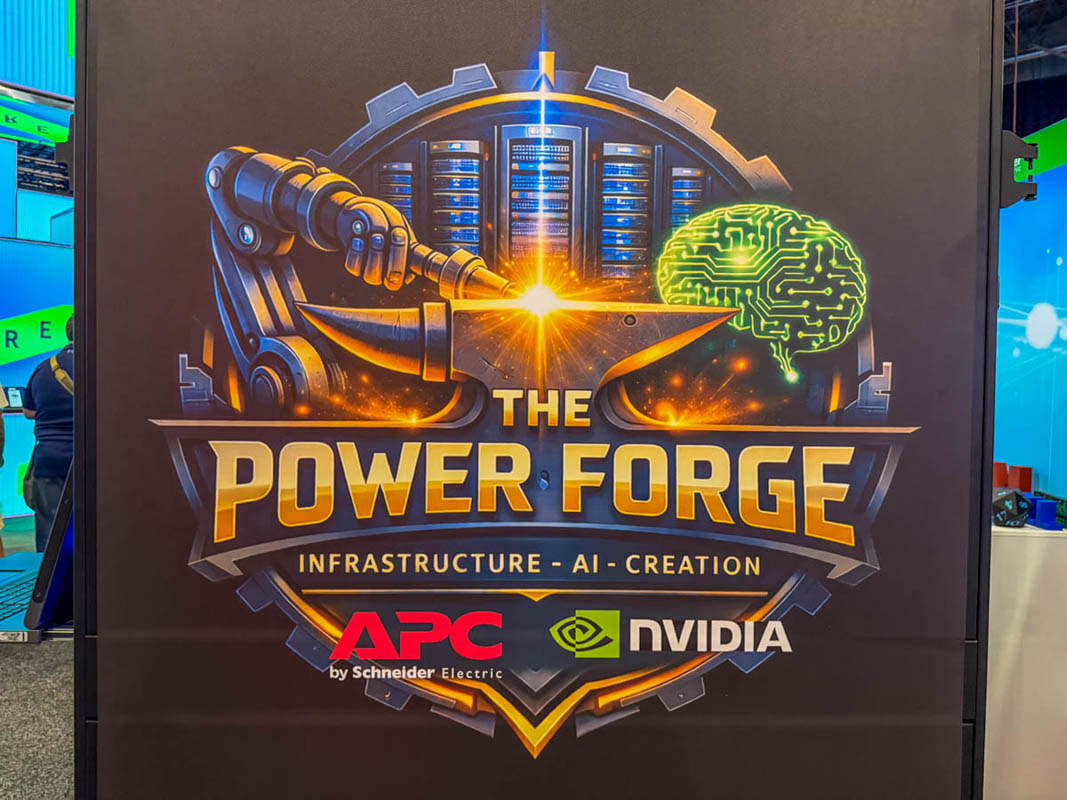
APC PowerForge: Innovation at Dell Tech World 2026
Dell Tech World 2026 hosted the unveiling of a solution poised to redefine the boundaries between digital ideation and physical realization: the APC PowerForge system. Developed in collaboration with Dell and NVIDIA, this integrated rack captured audience attention with a live demonstration showcasing its capability to transform a simple text prompt into 3D models, printed in real-time directly on the event stage.
This demonstration was not merely a stylistic exercise but a concrete illustration of the potential that artificial intelligence, and particularly Large Language Models (LLMs), can hold in the fields of design and manufacturing. The ability to transition from a verbal description to a physical object in just a few steps opens new perspectives for sectors ranging from rapid prototyping to on-demand manufacturing, highlighting how hardware-software integration is becoming increasingly sophisticated.
Technical Details and Design Implications
The core of the APC PowerForge system lies in its integrated architecture, combining Dell's computing power with NVIDIA's AI acceleration capabilities. While specific hardware details, such as GPU VRAM or exact throughput, were not disclosed, NVIDIA's involvement suggests the use of high-performance Graphics Processing Units (GPUs), essential for the inference and training of complex AI models. These models are capable of interpreting natural language and translating it into geometric instructions for 3D printing.
The most significant implication of such a pipeline is the drastic reduction in development and iteration times. Traditionally, creating a 3D model from an idea requires specific skills in CAD software and a manual process. With PowerForge, an engineer or designer could simply describe the desired object, and the system would generate the model, ready for printing. This not only democratizes access to advanced prototyping but also accelerates the entire product lifecycle, from concept to production.
The Context of On-Premise Deployment
The choice to present PowerForge as a "rack" suggests a clear orientation towards on-premise deployment solutions. For companies operating in sectors with stringent requirements regarding data sovereignty, regulatory compliance, or intellectual property protection, maintaining AI workloads within their own infrastructure is a priority. A self-hosted system like PowerForge offers complete control over the entire pipeline, from text input management to physical output, ensuring that sensitive data never leaves the corporate environment.
This on-premise approach also allows for optimizing the Total Cost of Ownership (TCO) in the long run, especially for consistent and predictable workloads. While the initial investment in hardware and infrastructure (such as power and cooling) can be significant, the variable operational costs associated with cloud services are eliminated. Furthermore, the low latency offered by a local infrastructure is crucial for iterative design and production processes, where every millisecond can make a difference. For those evaluating on-premise deployment for AI/LLM workloads, AI-RADAR offers analytical frameworks at /llm-onpremise to assess the trade-offs between self-hosted and cloud solutions.
Future Prospects and Final Considerations
The APC PowerForge demonstration at Dell Tech World 2026 is a strong signal of the direction artificial intelligence integration is taking in industrial processes. The ability to generate physical objects from textual descriptions is no longer science fiction but a tangible reality poised to enter factories and research centers. This paves the way for a new era of personalized, on-demand production, where flexibility and speed become crucial competitive advantages.
The adoption of integrated and AI-optimized solutions, such as the PowerForge rack, will be fundamental for companies aiming to stay at the forefront. The synergy between robust hardware, advanced AI computing capabilities, and 3D printing represents a powerful ecosystem for innovation, prompting organizations to carefully consider their deployment strategies, balancing the benefits of on-premise control with scalability and performance needs.





💬 Comments (0)
🔒 Log in or register to comment on articles.
No comments yet. Be the first to comment!