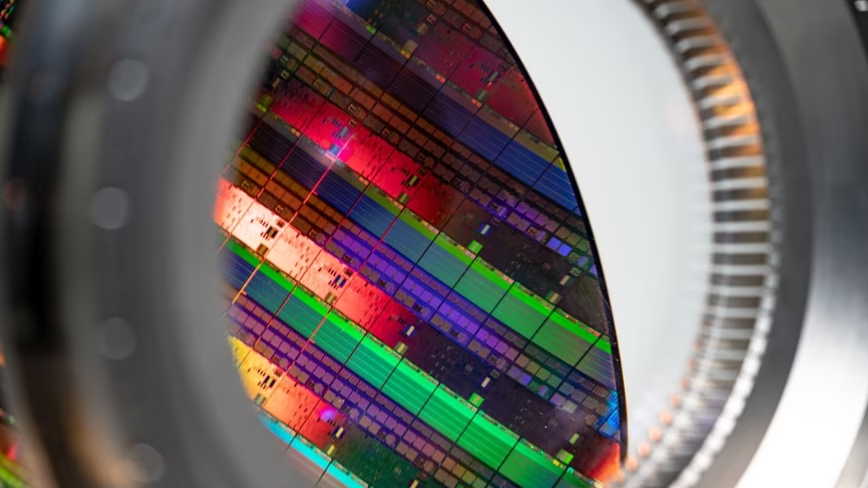
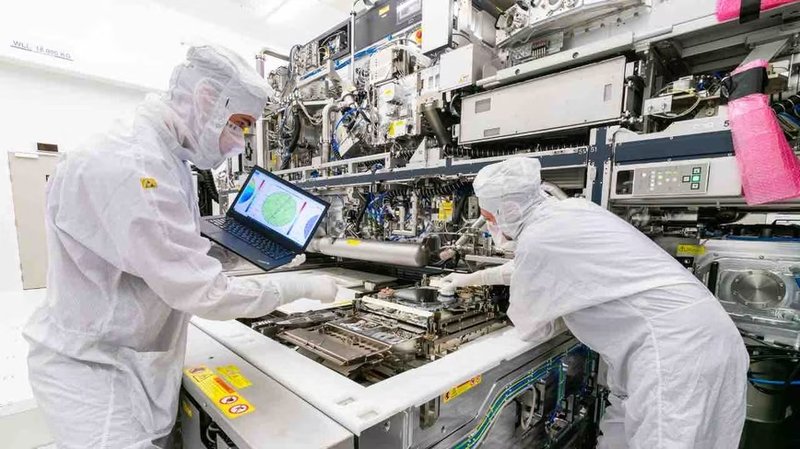
The heart of the AI hardware supply chain beats in Veldhoven’s cleanrooms. ASML is working to slash by roughly a third the time it takes to build and test its extreme ultraviolet lithography machines – the very tools that pattern the advanced-node chips on which LLMs and distributed training systems run.
The news comes from CFO Roger Dassen, who told reporters on Wednesday that the cycle time – from initial cleanroom work to shipping – stood at about 22 weeks a few quarters ago. The goal now is to compress it significantly, boosting output without necessarily building new factories.
This is no arcane detail for specialists: ASML’s EUV machines remain the primary upstream bottleneck for GPU, accelerator, and custom AI chip production. Without a faster flow of these tools, any projection of advanced silicon supply growth risks staying theoretical.
Why EUV is the real gatekeeper for on-premise AI
When a company weighs on-premise deployment for LLMs, multiple factors feed the TCO analysis: GPU cost, power draw, procurement lead times. Less visible but structural is the dependence on a technology with a single supplier and a lead time measured in months. EUV machines are indispensable for 7 nm and below nodes, where virtually all chips for large-scale inference and training are made – from NVIDIA H100s to Google and Amazon custom silicon.
Shaving 30% off the build cycle doesn’t magically multiply the number of GPUs on the market overnight, but it does shift the constraint. If ASML delivers more machines faster, chipmakers can plan capacity expansions with greater confidence. And in an industry where stock is absorbed within weeks, supply certainty is an asset that travels downstream to the racks populating on-premise datacenters.
There’s a second-order effect on procurement strategies, too. Companies that are currently postponing AI infrastructure investments due to component wait times might revisit their plans if ASML’s message translates into a steadier flow. It’s not an immediate gain, but rather a signal that the supply chain is starting to respond to demand pressure instead of just absorbing it.
The bottleneck may simply migrate, of course: more EUV machines mean more wafers, but they also require advanced packaging capacity, HBM memory, and substrates – all links the industry is already scrambling to reinforce. ASML’s promised acceleration isn’t a silver bullet, but it is the kind of move that, if sustained, makes planning less speculative for those determined to bring AI inside their own walls.






💬 Comments (0)
🔒 Log in or register to comment on articles.
No comments yet. Be the first to comment!