
ASML and the High-NA Chip Era: A Step Forward for AI
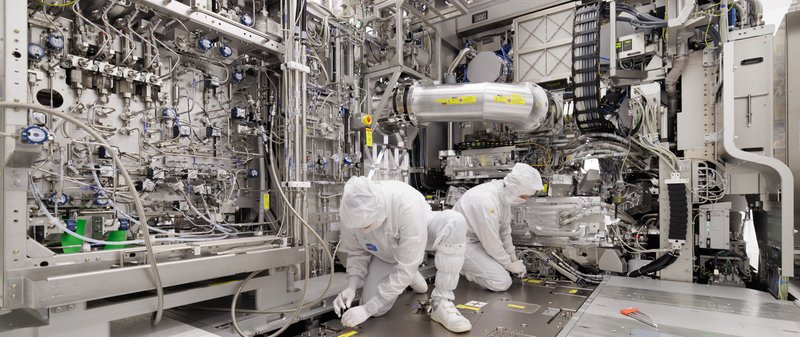
ASML, a leading company in semiconductor manufacturing equipment, is nearing a significant milestone: the delivery of its first next-generation extreme ultraviolet (EUV) lithography systems, known as High-NA, within the coming months. This technology represents a crucial evolution in the chip fabrication process, promising to further push the limits of transistor miniaturization. The impact of such innovations is profound, especially for computationally intensive sectors like artificial intelligence and the development of Large Language Models (LLM).
This announcement comes amidst a growing demand for computing power, where every improvement in chip efficiency and density translates into superior capabilities for training and inference of increasingly complex AI models. However, the introduction of these cutting-edge technologies is not without its challenges, particularly regarding costs, a factor that will directly influence deployment strategies and the Total Cost of Ownership (TCO) for companies investing in self-hosted AI infrastructures.
High-NA EUV Technology: Details and Implications for Silicon
High-NA EUV (Extreme Ultraviolet with high numerical aperture) lithography is the next frontier in semiconductor manufacturing. This technology enables the printing of circuits with even finer details than the previous generation of EUV, reducing transistor sizes and increasing component density on a single chip. This is fundamental for creating more powerful and efficient processors, including specialized AI chips like GPUs and dedicated accelerators.
For the world of artificial intelligence, the adoption of chips produced with High-NA EUV means the possibility of hardware with greater VRAM, higher throughput, and improved energy efficiency. These attributes are indispensable for handling LLM workloads that require enormous amounts of memory and computing power, both for large-scale training and low-latency inference. The availability of such advanced silicon is a prerequisite for the evolution of increasingly sophisticated AI models and their effective deployment in on-premise environments.
Costs, TCO, and Data Sovereignty in the High-NA Era
The "cost concerns" mentioned in relation to High-NA EUV technology are a critical aspect. ASML's lithography systems are among the most complex and expensive machines in the world, and the introduction of the High-NA variant further raises the stakes. These costs are reflected throughout the entire supply chain, influencing the final price of chips and, consequently, the initial investment (CapEx) for companies building or expanding their AI infrastructure.
For CTOs and infrastructure architects evaluating self-hosted solutions for their AI workloads, TCO becomes a decisive factor. Investing in state-of-the-art hardware, while offering superior performance, must be balanced with long-term operational costs, including energy and maintenance. The ability to produce chips with such advanced technologies also has geopolitical and data sovereignty implications, as control over silicon production is increasingly strategic for ensuring technological autonomy and compliance in air-gapped environments.
Future Prospects for On-Premise AI Deployment
The imminent availability of chips produced with High-NA EUV technology marks a significant acceleration in the hardware capabilities available to the AI sector. On one hand, it promises to unlock new heights of performance for LLM training and inference, enabling larger and more complex models with greater efficiency. On the other hand, it necessitates careful consideration of costs and TCO, especially for organizations prioritizing on-premise deployment for reasons of control, security, and data sovereignty.
The choice between investing in cutting-edge hardware and managing its associated costs, or opting for alternative solutions, will become even more complex. For those evaluating on-premise deployments, significant trade-offs exist between performance, initial, and operational costs. AI-RADAR offers analytical frameworks on /llm-onpremise to evaluate these trade-offs, providing tools for informed decision-making without direct recommendations, but highlighting the constraints and opportunities of each approach. The ability to balance technological innovation and economic sustainability will be key to the success of future AI strategies.








💬 Comments (0)
🔒 Log in or register to comment on articles.
No comments yet. Be the first to comment!