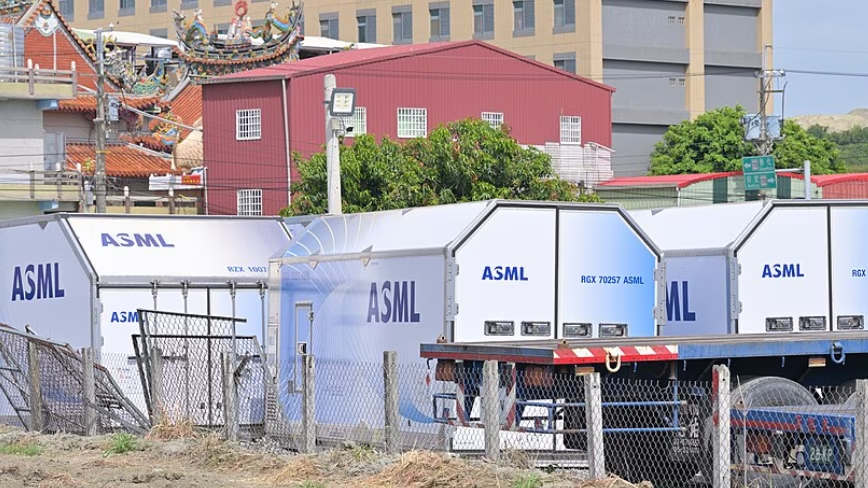
Every employee gets a €20,000 share award. It’s not the launch of a Silicon Valley startup, but the move by ASML, the Dutch lithography giant, to secure its human capital. The news, confirmed Friday, grants a one-time bonus to all 45,000 workers worldwide, vesting only if they stay until January 1, 2030. It’s a retention tool that mirrors the unprecedented pressure on the semiconductor supply chain, driven by artificial intelligence demand.
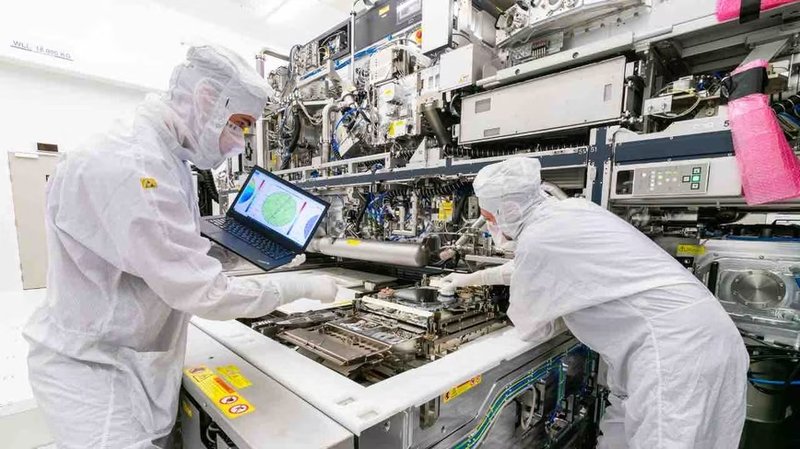
ASML is the sole producer of extreme ultraviolet (EUV) lithography machines, indispensable for fabricating the most advanced chips, those at 7 nanometers and below. Without these tools, there would be no NVIDIA H100 GPUs, nor the processors that train today’s Large Language Models. The explosive growth of AI has pushed orders — and revenue — to record levels, prompting the company to lock in engineers and technicians in a field where expertise is scarce and development cycles span decades.
Behind the bonus, however, lies much more than an HR tactic. It signals an industrial concentration that is becoming a friction point for the entire AI ecosystem. ASML’s EUV machines take years to build, cost hundreds of millions of dollars each, and are produced in limited volumes. Every advanced chip fab — from TSMC to Samsung, from Intel to new entrants — depends on these deliveries. If AI demand continues to surge, the bottleneck becomes structural, with direct consequences for the availability of inference and training hardware.
For organizations evaluating on-premise architectures, the message is clear. Those planning data centers for private LLMs, perhaps for data sovereignty or operational control, must contend with an inelastic supply chain. Lead times for high-end GPUs stretch, and total cost of ownership (TCO) risks climbing. It’s no surprise that techniques like quantization, fine-tuning of smaller models, and alternative accelerators are gaining attention as ways to reduce reliance on the most contested hardware.
The story also has a geopolitical dimension. Export restrictions on advanced technology imposed by the US and others turn EUV machines into instruments of economic power. The Netherlands — and by extension Europe — controls an irreplaceable link in the chain. For an industry debating digital sovereignty, outsourcing computational capacity to chips that absolutely must go through a single supplier is a risk that cannot be overlooked.
In this light, the €20,000 bonus is not a tale of corporate perks but a warning about the fragility of a hyper-concentrated ecosystem. While AI races ahead, the chip supply chain struggles to keep up, and anyone building compute infrastructure must account for variables that go far beyond the cloud-vs-private datacenter debate. AI-RADAR tracks these dynamics to provide analytical tools for those deciding where and how to run their models.






💬 Comments (0)
🔒 Log in or register to comment on articles.
No comments yet. Be the first to comment!