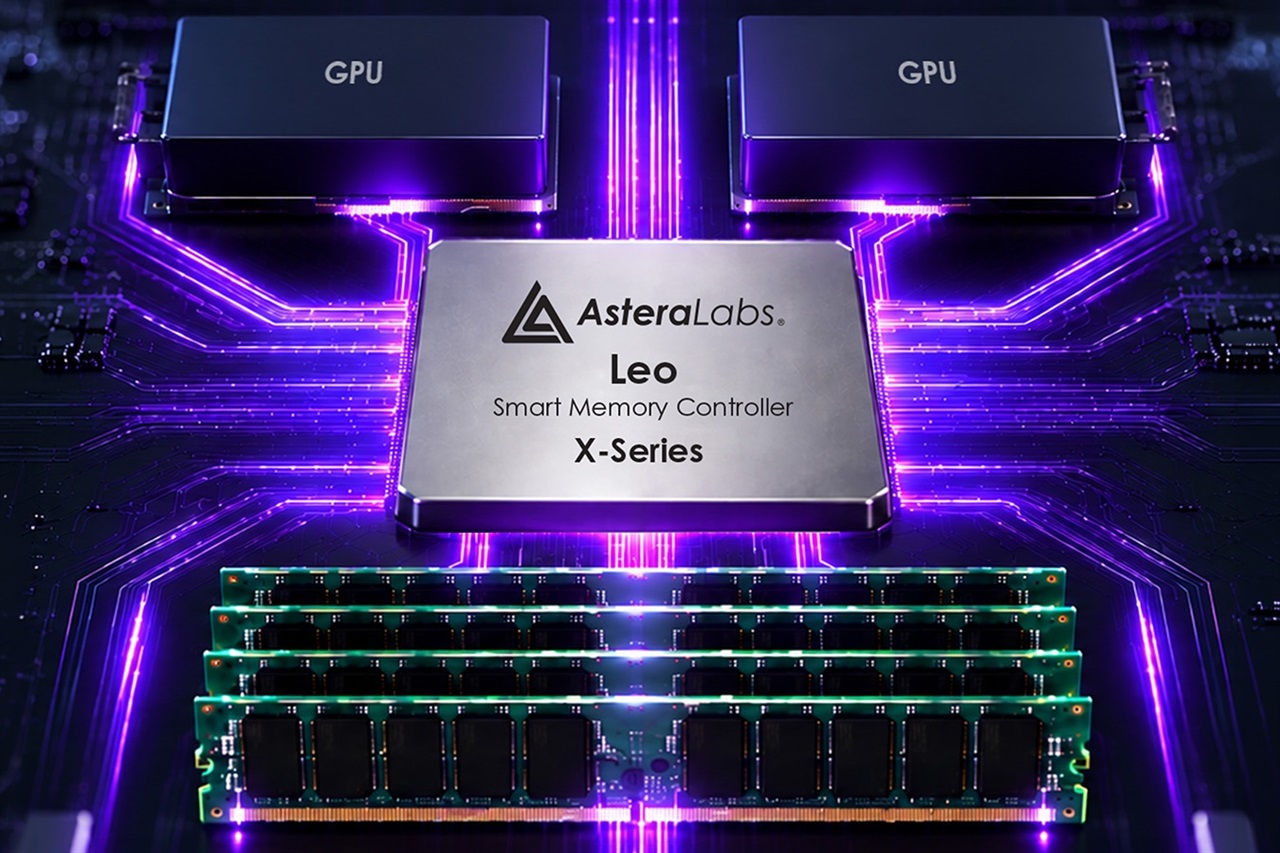
Astera Labs has set its sights on a problem many LLM deployments encounter when moving from experimentation to production: the KV cache. In transformer models, this structure stores for each token the intermediate representations needed for attention. With longer contexts and agentic workloads, token counts grow quickly and the cache ends up consuming a significant share of the VRAM available on GPUs. This is not an implementation detail; it is a physical constraint that affects how many jobs can run in parallel, latency, and infrastructure TCO.
Astera Labs' decision to focus on this bottleneck says a lot about how the industry is reshuffling priorities. For years AI hardware was discussed mostly in terms of compute power and core throughput. But agentic workloads, which chain multiple calls and keep shared state, shift pressure toward memory and interconnects. When VRAM runs out, the options are limited: reduce precision through quantization, limit context length, or move parts of the cache off the GPU. Each path introduces trade-offs in quality, latency, or complexity.
Astera Labs' interest in this specific bottleneck signals that adding more GPUs alone does not solve the problem. A broader, coherent memory hierarchy is needed, one in which the KV cache can live beyond local VRAM limits without making inference unusable. This has direct implications for on-premise and self-hosted deployments. An infrastructure that keeps data local must be sized not only for peak compute, but also for memory behavior in multi-turn and multi-agent scenarios. And costs are not just CapEx: deciding how much memory to keep near the GPU and how much to handle over the network affects power consumption, cooling, and operational complexity.
Strategically, Astera Labs' move reinforces a message: the next generation of LLM infrastructure will not be won by whoever has the fastest chip, but by whoever controls data movement best. Memory and connectivity suppliers can carve out a central role, while compute-only vendors risk losing relevance as the bottleneck shifts. For organizations evaluating local stacks, this means selection criteria must include KV cache behavior and memory flexibility, not just peak benchmarks. AI-RADAR provides analysis on /llm-onpremise for those who want to explore these trade-offs without shortcuts.







💬 Comments (0)
🔒 Log in or register to comment on articles.
No comments yet. Be the first to comment!