
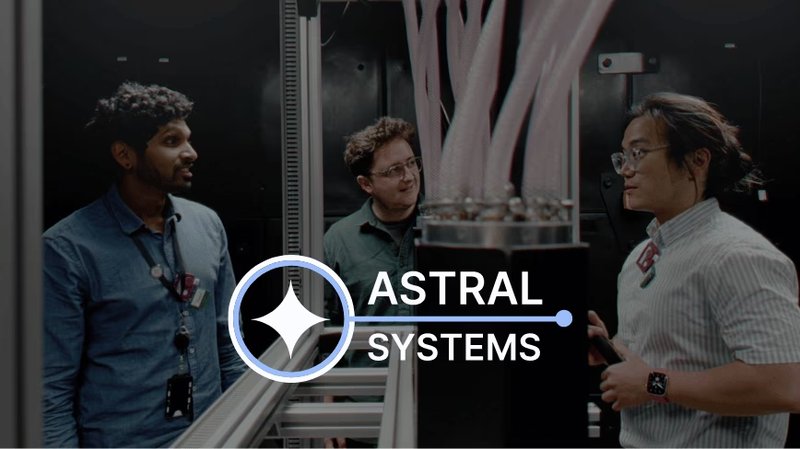
The global supply chain for medical radioisotopes is a house of cards. A single disruption at one of the handful of ageing nuclear reactors worldwide can put cancer diagnoses and treatments at risk. With a £23 million investment led by Mercia Ventures, UK-based Astral Systems aims to dismantle this fragility by bringing production directly to hospitals and research centres using compact, on-premise fusion reactors.
The round pushes the company’s total funding past £28 million and signals a shift in a field that has long viewed fusion only as a distant energy source. Astral already operates TRL9 reactors – the highest technology readiness level, proven in real environments – and generates revenue from research contracts. Now it plans to turn plasma physics into a commercial business, with the first medical isotopes expected by early 2027.
Fusion that doesn’t wait for the sun
Astral’s reactors rely on Multi-State Fusion (MSF), a different beast from the thermonuclear fusion chasing energy breakeven. Instead of aiming for ignition, the compact devices operate in steady-state fusion, bombarding targets with high-intensity neutrons. This volumetric flux continuously produces isotopes such as technetium-99m or radium-223, with greater efficiency and lower costs than traditional fission reactors or cyclotrons. The modular architecture allows scaling by adding units – a familiar concept to anyone in enterprise IT evaluating on-premise inference clusters: rather than relying on centralised cloud, you distribute capacity where needed, reducing latency and geopolitical risk.
Healthcare sovereignty and the supply chain knot
The UK long ago lost the ability to produce many medical isotopes domestically, forcing the NHS to import them from reactors in Europe, South Africa, or Canada. Every maintenance shutdown or geopolitical event triggers shortages. Astral’s bet – to localise reactor farms at sites like the former Berkeley Power Station, which by end 2026 should host the world’s highest-flux private volumetric neutron source – mirrors in the physical realm the data sovereignty drive pushing organisations to run AI workloads on self-hosted hardware. Direct control over production infrastructure, whether bits or atoms, removes external bottlenecks and dependencies, with a direct impact on operational continuity and, in this case, patient waiting lists.
Grafting nuclear physics onto industrial logic
Astral Systems isn’t limiting itself to medicine. Its partnership with the University of Bristol on tritium breeder blanket research, and a UK grant to explore the technology as a testbed for advanced fission fuels, hint at a wider scope. The hiring of NASA scientist Dr Theresa Benyo as Chief Research Officer strengthens the technical bench. The company embodies a trend AI-RADAR also sees in the LLM world: the rise of highly specialised, vertical solutions that start from a niche problem (medical isotopes here, quantised inference on legal documents there) to build a competitive moat before expanding. With three commercial facilities already active and over £3 million in research revenue, the path to economic sustainability looks less like a mirage.
Regulatory frameworks and ongoing investment will be needed to bring compact fusion reactors into non-specialised settings. Yet the direction is clear: just-in-time production, supply chain resilience, local control. Principles that IT architects know well when designing on-premise deployments for sensitive data. With its £23 million round, Astral Systems accelerates a parallel transition in the physical world, giving hospitals and research centres the power to produce what they need, when they need it.






💬 Comments (0)
🔒 Log in or register to comment on articles.
No comments yet. Be the first to comment!