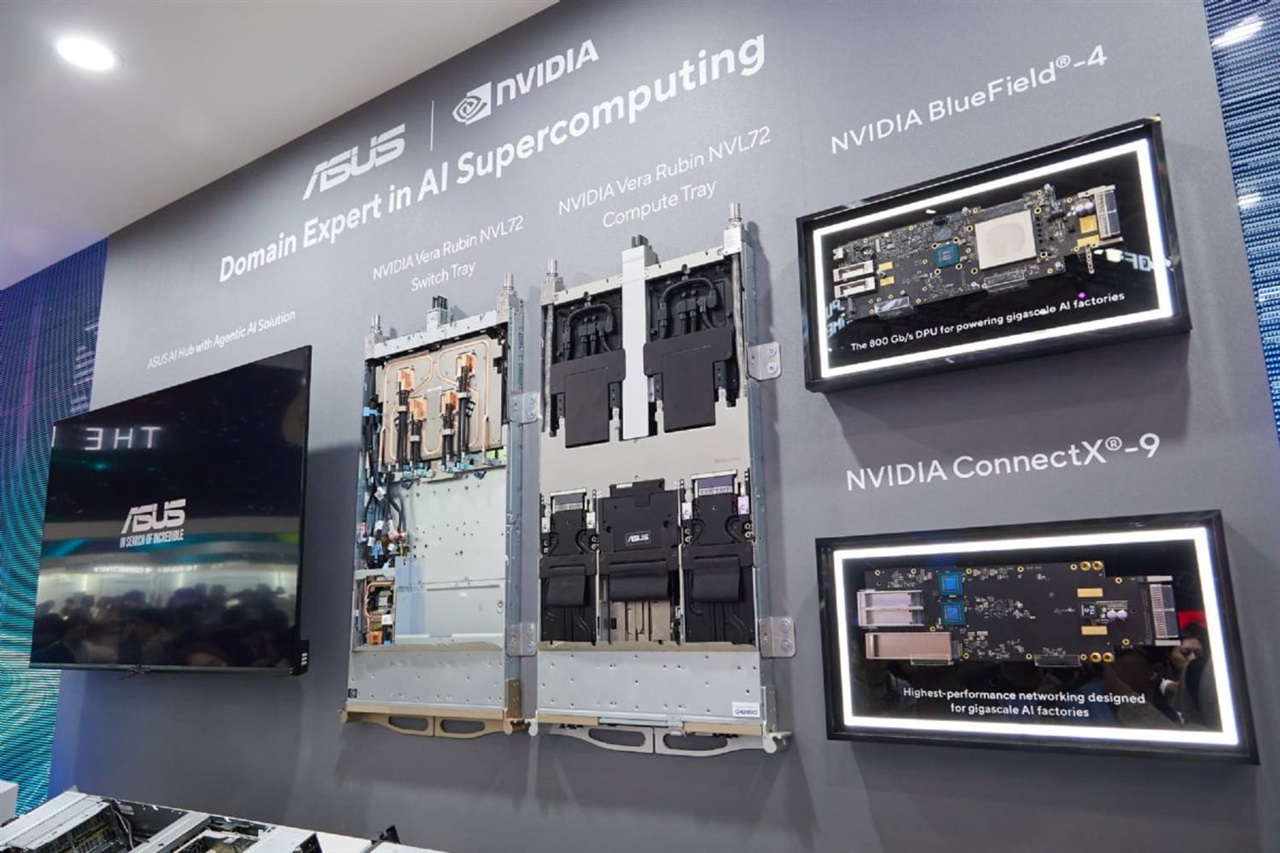
The news comes from DIGITIMES and has the feel of a watershed: in June 2024, Asus recorded monthly revenue that exceeded NT$100 billion, a figure no single month had ever reached before. The performance was driven not by notebooks or motherboards, but by artificial intelligence servers.
The data point is more than an accounting milestone. It speaks of enterprise demand accelerating beyond expectations and progressively shifting from cloud-only architectures toward hybrid and on-premise scenarios. When a manufacturer like Asus — historically strong in the system integrator and SME channel — sees its revenue explode because of AI servers, it means that hardware for inference and training is no longer the exclusive domain of large hyperscalers.
Who is buying these servers and why it matters
The customer profile at this stage is composite: research labs, companies performing fine-tuning of LLMs on proprietary data, managed service providers setting up private clouds compliant with GDPR. For all of them, on-premise deployment is not just an architectural choice but a sovereignty and control constraint. Asus, with its manufacturing capacity in Taiwan and direct access to the GPU supply chain, intercepts a market segment that seeks alternatives to the integrated platforms of big vendors.
The second-order impact is clear: the more suppliers compete for customers, the more the offering branches into configurations customizable for VRAM, throughput, and power consumption. And for anyone evaluating a local LLM deployment, this reduces the risk of lock-in and can lower TCO over the medium term. That’s no minor detail in a sector where accelerator availability is still subject to shortage cycles.
The role of the Taiwanese hardware supply chain
Asus’s growth is not an isolated phenomenon. It should be read alongside the numbers from Quanta, Wistron, and Foxconn, all of which have recorded significant increases precisely because of AI server demand. The Taiwanese manufacturing backbone is becoming the mandatory crossroads for anyone wanting to deploy high-density computing infrastructure. This also means that competition on pricing and delivery timelines will intensify, with direct repercussions on the planning of on-premise hardware investments.
At the same time, the issue of energy efficiency cannot be overlooked. Racks housing cutting-edge GPUs pose cooling and power challenges that manufacturers like Asus are already starting to address with modular solutions. For an organization planning to run LLM inference behind its own firewall, thermal efficiency is not an option: it is a decisive element in the total cost calculation.
Third-order implications touch the software stack. When hardware steps out of the sphere of large cloud providers, pressure increases on orchestration and serving ecosystems — from vLLM to Ollama — to run frictionlessly on heterogeneous platforms. By certifying entire configurations for generative AI workloads, Asus and its competitors indirectly accelerate the maturity of open-source frameworks as well.
Ultimately, the NT$100 billion news is not a mere financial flash. It is an indicator of the infrastructure consolidation phase of AI, in which on-premise hardware gains relative weight and vendor diversification shifts the decision-making center of gravity toward enterprises that want to maintain control over their data. For those following local deployment dynamics, it’s a signal that goes well beyond a single manufacturer’s quarterly report.








💬 Comments (0)
🔒 Log in or register to comment on articles.
No comments yet. Be the first to comment!