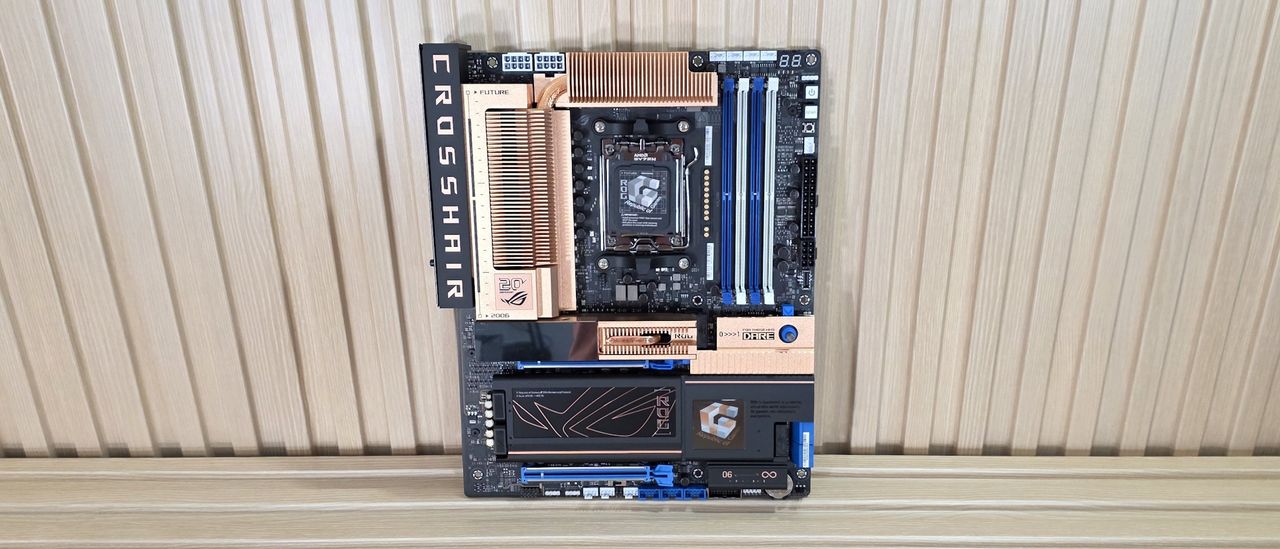
Asus ROG Crosshair 2006: A Turning Point for High-End Hardware
In 2006, the introduction of the Asus ROG Crosshair motherboard represented a significant moment for the high-performance hardware market. This model, part of the newly launched Republic of Gamers (ROG) line, was designed to meet the needs of enthusiasts and overclockers, offering advanced features and a robust construction that set new standards at the time. Its market debut coincided with the beginning of an era where extreme performance was no longer the exclusive domain of servers but began to permeate the consumer segment, laying the groundwork for future technological evolutions.
The celebration of twenty years of the ROG brand, which accompanied the launch of products like the Crosshair 2006, highlights a trajectory of constant innovation. From its origins, ROG focused on optimizing every single component, from power management to cooling systems – elements that have now become crucial in the context of artificial intelligence workloads. This attention to detail and performance has created a legacy that continues to influence contemporary hardware development, especially for infrastructures that must support computationally intensive applications.
The Evolution of Hardware for AI Workloads
Today's technological landscape is dominated by the growing demand for computing power for Large Language Models (LLM) and other artificial intelligence applications. Although the Crosshair 2006 was intended for gaming, the engineering principles that guided it – stability, overclocking capability, and support for high-end components – are more relevant than ever. Modern motherboards and system architectures must handle extremely high power requirements, support multi-GPU configurations with large amounts of VRAM, and ensure consistent, low-latency data throughput.
For on-premise LLM deployments, choosing a robust hardware platform is fundamental. Components like motherboards must offer an adequate number of PCIe slots for installing multiple graphics accelerators, a power delivery section (VRM) capable of providing stable and clean power, and efficient cooling solutions. These aspects are directly related to an infrastructure's ability to sustain prolonged training sessions or intensive inference workloads, directly impacting the Total Cost of Ownership (TCO) through energy efficiency and component longevity.
Implications for On-Premise Deployments and Data Sovereignty
The decision to adopt a self-hosted infrastructure for AI workloads is often driven by needs for data sovereignty, regulatory compliance, and total control over the operating environment. In this scenario, the quality and reliability of the foundational hardware, such as the motherboard, become critically important. A robust and well-designed system reduces downtime risks, improves performance predictability, and allows for greater flexibility in resource management.
For companies operating in regulated sectors or handling sensitive data, the ability to keep models and data within an air-gapped or otherwise strictly controlled environment is a non-negotiable requirement. The foundational hardware, while not directly responsible for logical security, forms its physical basis. Choosing higher-quality components with an architecture designed for scalability and resilience is therefore a strategic investment that supports security and compliance objectives, in addition to optimizing performance for LLM inference and fine-tuning.
Future Prospects and Strategic Choices for AI
The legacy of innovation left by products like the Asus ROG Crosshair 2006 continues to inform design choices in modern hardware, especially in an AI-dominated era. CTOs, DevOps leads, and infrastructure architects face the challenge of building systems that not only meet current computing needs for LLMs but are also ready for future evolutions. This implies a careful evaluation of trade-offs between initial cost, scalability, energy efficiency, and integration capabilities with local software stacks.
Evaluating on-premise versus cloud solutions for AI workloads requires an in-depth analysis of these factors. AI-RADAR offers analytical frameworks on /llm-onpremise to help decision-makers navigate these complexities, providing tools to assess TCO, data sovereignty implications, and the concrete hardware specifications required. The history of products like the Crosshair 2006 reminds us that the foundation of any high-performing system is solid, well-designed hardware – a lesson that remains valid even in the age of artificial intelligence.





💬 Comments (0)
🔒 Log in or register to comment on articles.
No comments yet. Be the first to comment!