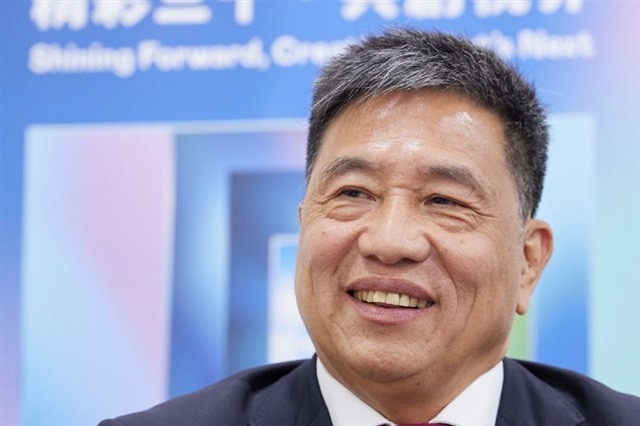
AUO has decided to accelerate its digital-era transformation with a two-pronged move: a management reshuffle and the launch of a dedicated innovation institute. Chairman Paul Peng has chosen to shuffle the internal deck just as the display sector faces competitive pressure and artificial intelligence begins to reshape production lines.
This is not a simple reorganization. The new institute, according to what filters out of Hsinchu, is meant to act as a catalyst for applied AI projects, from predictive maintenance on lithography equipment to quality control based on neural networks. It’s a signal that even a traditional manufacturing giant feels the urgency not to be left behind when competition shifts to the terrain of data and algorithms.
For those observing the game from the perspective of computing infrastructure, AUO’s move raises deeper questions. Integrating AI in an industrial context often means dealing with sensitive data generated by factory sensors, process secrets, and supply chain information. Sending everything to the cloud is not always feasible: latency, data transfer costs, and compliance push many companies to evaluate on-premise or hybrid deployments. An internal institute, if equipped with adequate computing resources, can become the place to experiment with large language models (LLMs) to codify the tacit knowledge of specialized workers, or to fine-tune machine vision systems without a single frame leaving the plant.
Of course, the path is not without obstacles. Setting up a training environment for complex models requires hardware expertise well known to the self-hosted community: cards with ample VRAM, low-latency networks, and robust data pipelines. The trend toward model quantization, for example with INT8 or FP16 techniques, can make inference more accessible on less demanding machines, but it is not enough to erase the Total Cost of Ownership (TCO) challenge. An innovation institute focused on AI will have to deal with these choices, balancing CapEx and OpEx according to expected workloads.
Perhaps the most interesting aspect is the geopolitical context. AUO operates in an ecosystem—that of Taiwanese semiconductors and displays—increasingly at the center of tensions over technological sovereignty. Having local computing capacity, not dependent on extra-regional cloud providers, can take on a strategic value that goes beyond simple savings. For a company that produces critical components for global electronics, data security is not optional.
Ultimately, AUO’s reorganization should not be read merely as management news. It represents yet another piece of a broader movement: manufacturing companies are realizing that artificial intelligence is not a technology to be entirely delegated to external partners. The building of internal skills and the choice of an adequate computing infrastructure are becoming an integral part of competitive strategy. For those evaluating on-premise deployment, the trade-offs between control, cost, and flexibility remain at the heart of the debate.





💬 Comments (0)
🔒 Log in or register to comment on articles.
No comments yet. Be the first to comment!