The interconnect bottleneck
Modern AI clusters are thirstier for bandwidth than ever. As LLM parameters grow, inference throughput and training time depend less on raw GPU power and more on the network's ability to keep pace. AuthenX has announced it is taking aim at this very challenge with a fiber array unit (FAU) designed for co-packaged optics (CPO), targeting data centers that host artificial intelligence workloads.
In the world of AI interconnects, the shift toward CPO is a path to reduce latency and power consumption. Instead of placing transceivers away from the switch ASIC, CPO integrates optical engines directly into the chip package, shortening the electrical path and enabling higher density. The component AuthenX has presented positions itself as a plug-and-play element for managing fiber fan-out—a detail that, in high-intensity on-premise environments, can simplify assembly and maintenance.
CPO and FAU: innovation in optical packaging
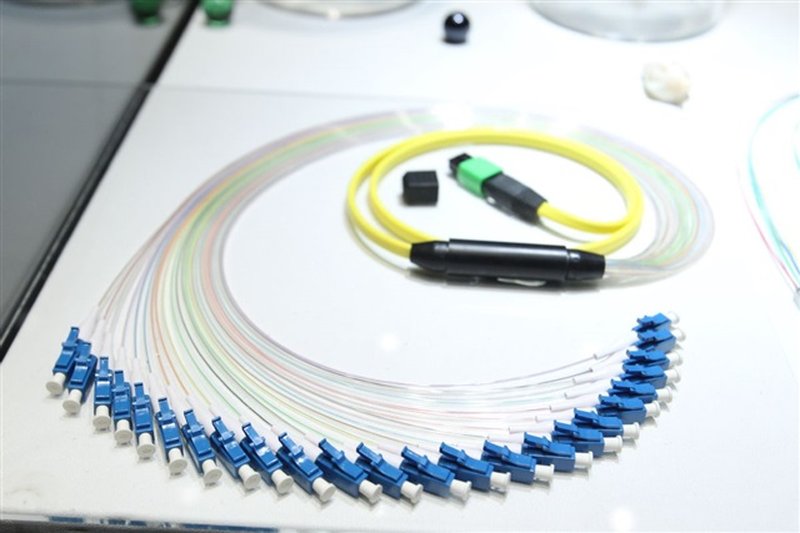
The fiber array unit is a passive yet critical component: it aligns and connects fibers to optical engines with minimal tolerances. The CPO scheme moves coupling complexity from the rear of the panel to the proximity of the package, and the FAU must adapt to non-standard geometries. AuthenX claims a “plug-and-play” approach that could lower one of the practical barriers to CPO adoption in large-scale AI data centers, where every deployment site must contend with staff not specialized in fiber optics.
Looking at distributed inference, choices like these directly touch the trade-offs that AI-RADAR tracks for those evaluating on-premise stacks: lower communication latency between nodes means being able to leverage sharded models without degradation and facilitates more efficient scheduling strategies on local clusters. In addition, for self-hosted architectures, reducing the number of transceivers and eliminating intermediate power supplies translates into a concrete impact on TCO.
Simplifying on-premise deployment
The plug-and-play character announced by AuthenX is no frill: in private data centers, where network infrastructure teams often lack specialized fiber skills, simplified integration reduces installation errors and downtime. A factory-aligned and tested FAU connector shortens the last mile of internal optical cabling, allowing a shift from manually wired configurations to easily inspectable and replaceable modules.
For those managing AI clusters under data sovereignty requirements, every infrastructure component that lowers operational complexity is an asset. In this scenario, choosing a CPO interconnect with a dedicated FAU can be read as a piece of a more modular and repairable architecture, without introducing dependencies on overly integrated proprietary solutions. AI-RADAR watches these dynamics closely, because the decision between traditional optics and CPO is not merely technical: it touches procurement costs, component replaceability, and the team's learning curve.
Beyond speed: implications for private AI
The real proving ground for a plug-and-play FAU will be its ability to sustain escalating signaling rates without introducing degradation. As NVLink and Infinity Fabric roadmaps push toward terabits per second, optical coupling becomes the next critical link. Working on components that simplify rack installation is not just a matter of convenience; it is an enabler for scaling on-premise AI clusters without multiplying complexity.
The arrival of solutions like AuthenX's signals that the AI interconnect market is maturing beyond the reference designs of major switch vendors, opening up space for suppliers focused on specific components. For decision makers evaluating on-premise deployment, this means more tangible choice and the ability to refine the architecture without being locked into monolithic stacks. It is a path AI-RADAR will continue to monitor, aware that every innovation at the physical layer reflects on the scalability of private artificial intelligence.









💬 Comments (0)
🔒 Log in or register to comment on articles.
No comments yet. Be the first to comment!