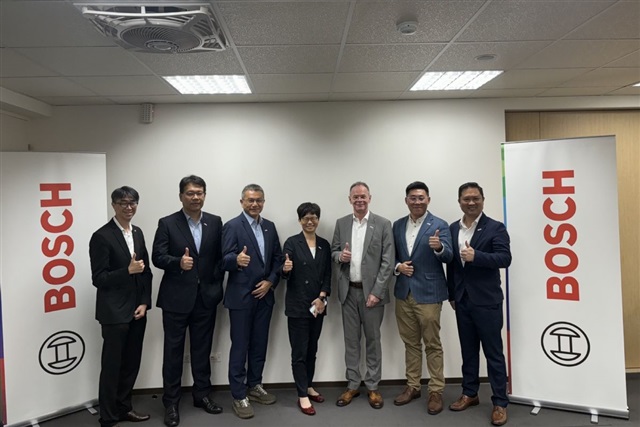
The figure, reported by Digitimes, is stark but telling: Bosch Taiwan recorded its highest-ever revenue for fiscal 2025, propelled by demand for artificial intelligence technologies. No details on specific orders or customer names, but the result arrives at a time when the entire AI supply chain—from sensors to power systems, all the way to chip manufacturing components—is posting staggering numbers.
Bosch’s invisible yet critical components
Those who focus solely on GPUs and VRAM forget that every LLM server is an ecosystem of precision mechanical, thermal, and electronic parts. Through its Mobility division and industrial technology, Bosch supplies microcontrollers, MEMS sensors, power management systems, and semiconductor manufacturing solutions. AI demand has triggered a chain reaction: more data centers, more chips, more wafers, and thus more automation tools and critical components. In Taiwan, the global foundry hub, Bosch’s presence intercepts this flow.
Why a supplier’s growth matters for on-premise deployment
This might seem like supply-chain news for insiders, but it has direct implications for those evaluating self-hosted architectures. Every inference node requires efficient power supplies, cooling systems integrating Bosch sensors, and production lines churning out the chips that run models. If suppliers like Bosch post records, it means the hardware pipeline is scaling—translating into greater component availability, potential medium-term TCO reduction, and less dependency on bottlenecks that stall on-premise projects. It’s not just about the cloud: AI demand is polarizing the industry, and enterprise DIY needs reliable physical building blocks.
The bigger picture
The AI boom extends beyond software layers. The market for basic components is boiling, and Bosch Taiwan embodies the positive tension between automotive, IoT, and industrial AI. While cloud vendors push managed services, a growing segment of organizations explores the local path due to data sovereignty and latency concerns. Bosch’s record is a thermometer: when second-tier suppliers shine, the on-premise ecosystem gets a concrete boost. The original Digitimes article doesn’t delve into technical details, but the macro signal is undeniable: money is flowing into the physical foundation of AI.
Outlook for infrastructure builders
For IT decision-makers, the Bosch Taiwan figure is a prompt to monitor supply-chain health. Components like current sensors and power modules are less glamorous than an H100 accelerator, but without them, on-premise inference goes nowhere. Those planning LLM clusters must look beyond silicon and consider supplier reliability, spare-part availability, and chain robustness. Bosch, with its industrial portfolio, is a proxy for that robustness. It’s no coincidence the news comes from Taiwan, the crossroads of global electronics manufacturing.







💬 Comments (0)
🔒 Log in or register to comment on articles.
No comments yet. Be the first to comment!