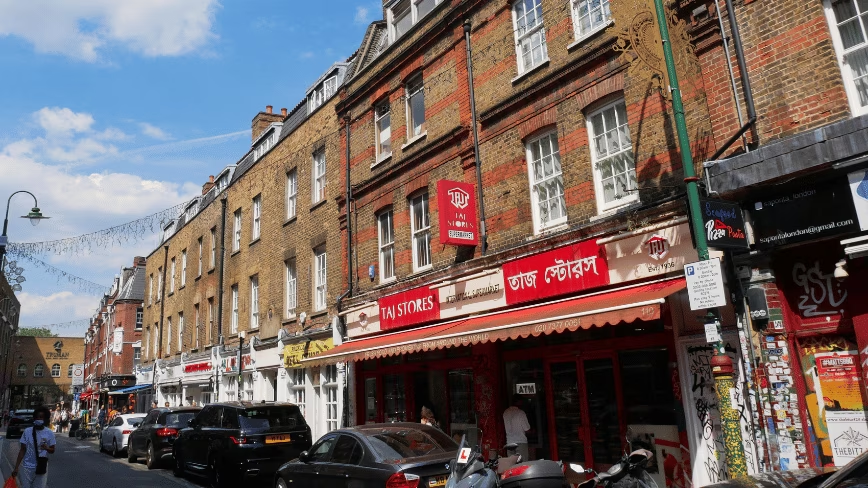
It’s not even for artificial intelligence. Yet the data center planned for Brick Lane, in the heart of London’s East End, is stirring the same opposition that now follows every high-density computing project. Residents want homes, not servers, and the fact that the racks would host high-frequency trading algorithms rather than large language models does little to soothe the conflict. The former Truman Brewery has become the latest flashpoint between computational demand and urban fabric.
This local story intersects a global dynamic that AI-RADAR tracks continuously: growing social friction around the physical infrastructure of the digital world. While public attention focuses on the environmental impact of LLMs and the hunger for GPUs, the question of space – where to physically locate servers, cooling systems, low-latency links – is turning into a structural constraint. For those deciding where inference and training should run, Brick Lane is not an exception; it’s a sign that centralized projects, even for non-AI workloads, face ever-stiffer resistance.
High-frequency trading is the extreme case of proximity dependence: every microsecond matters, and a data center a few kilometers from exchanges can be worth millions. But AI, too, with its latency demands for real-time applications, is pushing deployments closer to users or data. If a workload with such massive per-rack revenue struggles to get planning approval, the path for large GPU clusters looks even steeper.
The answer for many organizations will be to invest in distributed compute nodes inside existing facilities: on-premise, in factories, offices, hospitals. Instead of building new mega-centers, they will retrofit available spaces with servers capable of self-hosted inference. It’s a shift we’ve been watching for some time: data sovereignty, latency reduction, and now urban acceptance are driving a more fragmented AI infrastructure, less visible and more woven into the built environment. Paradoxically, Brick Lane’s opposition accelerates this transition: every no to a traditional data center is an indirect yes to distributed, on-premise deployments.
The lesson from East London is that compute, like energy, needs a social license to operate. Without new forms of architectural integration and transparency toward communities, tomorrow’s infrastructure will remain stuck in planning deadlocks, while workloads shift to smaller, less contested server rooms closer to those who use them.









💬 Comments (0)
🔒 Log in or register to comment on articles.
No comments yet. Be the first to comment!