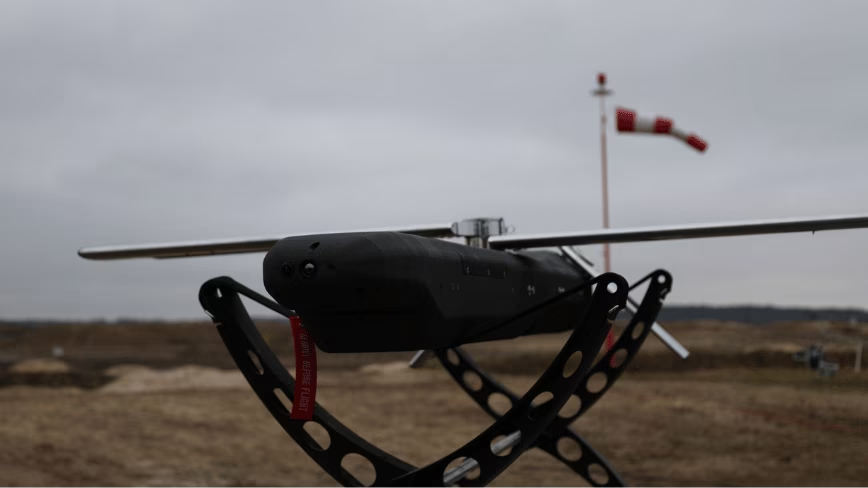
Cambridge Aerospace: A $300 Million Funding Round
Cambridge Aerospace, a British startup active in the defense technology sector, is reportedly in discussions for a significant funding round. According to Bloomberg, citing sources familiar with the matter, the company aims to raise approximately $300 million. This capital injection would boost its valuation to about $3.5 billion, an almost nine-fold increase from its value just a year ago.
Venture firm DFJ Growth is reportedly in talks to lead this funding round, underscoring growing investor interest in innovative solutions within the security and defense fields. Cambridge Aerospace focuses on developing advanced systems designed to shoot down drones and cruise missiles, an area where artificial intelligence plays an increasingly central role.
AI in Defense: Control and Sovereignty Requirements
Modern defense systems, such as those developed by Cambridge Aerospace, heavily rely on advanced artificial intelligence and machine learning capabilities. These include rapid threat detection and classification, predictive analytics, and autonomous response capabilities. For such critical applications, the choice of deployment infrastructure becomes paramount.
The need to ensure data sovereignty, operational security, and regulatory compliance often drives defense organizations to favor self-hosted or air-gapped solutions. On-premise deployment allows for complete control over the entire pipeline, from data acquisition to model inference, reducing risks associated with reliance on external providers or public cloud infrastructures. This approach is crucial for protecting sensitive information and ensuring systems operate even in environments with limited or no connectivity.
Market and Technology Implications
Cambridge Aerospace's impressive valuation growth reflects a broader trend: the acceleration of investments in AI-driven defense technologies. The ability to develop effective solutions against emerging threats like autonomous drones and cruise missiles has become a strategic priority for many nations. This drives demand for innovation in specialized silicon, machine learning frameworks, and system architectures that can support complex AI workloads with low latency and high reliability.
The defense sector requires not only high-performing models but also resilient infrastructure. This includes bare metal servers, GPUs with high VRAM for Large Language Models inference or complex vision models, and high-speed storage solutions. The ability to fine-tune models locally, without exposing sensitive data, is another key factor influencing deployment decisions.
The Value of On-Premise Deployment for National Security
For defense applications, Total Cost of Ownership (TCO) is measured not only in economic terms but also in terms of security and strategic control. The ability to keep data and algorithms within national borders or dedicated infrastructures is often a non-negotiable requirement. This scenario highlights the advantages of on-premise deployment, which offers granular control over every aspect of the infrastructure, from physical security to software updates.
For those evaluating on-premise deployment for AI/LLM workloads in critical sectors like defense, AI-RADAR offers analytical frameworks on /llm-onpremise to assess the trade-offs between control, security, performance, and TCO. The choice between proprietary infrastructure and cloud-based solutions is complex and requires a thorough analysis of operational and strategic constraints, especially when national security is at stake.










💬 Comments (0)
🔒 Log in or register to comment on articles.
No comments yet. Be the first to comment!