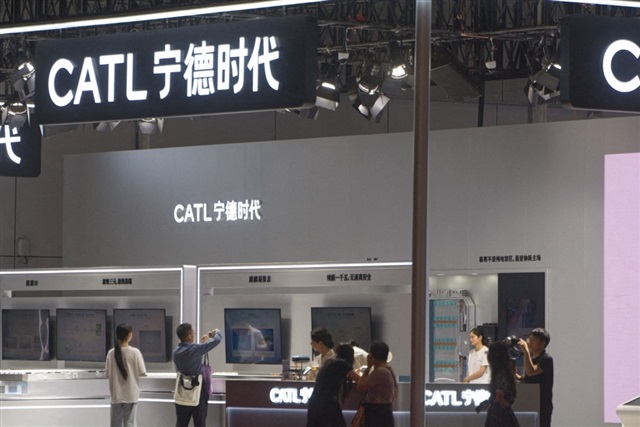
The company that produces batteries powering global electric mobility now wants to power its own artificial intelligence models with a different logic: less dependence on the cloud, more control over hardware and data, and a relentless focus on energy consumption. CATL, the Chinese giant that dominates the lithium-ion battery supply chain, is reshaping its AI strategy around two specific names: DeepSeek for language models and VNET for infrastructure. The announcement – still short on technical details – marks a turning point for anyone watching real-world LLM deployments.
The choice of DeepSeek is no accident. The Chinese startup has shown that models with a limited number of parameters and more efficient training techniques can compete with Western behemoths, drastically reducing cost per token and memory requirements. In an industrial setting like CATL’s, where intellectual property tied to manufacturing processes is strategic, being able to run inference on local hardware – without crossing public data centers – becomes a requirement for security and sovereignty. DeepSeek makes this feasible without needing massive GPU clusters, bringing on-premise within reach even for a manufacturing company.
VNET, for its part, brings expertise in orchestrating the entire infrastructure stack: data centers, networking, workload management. The picture is an architecture where models run on machines under CATL’s full control, likely in colocation or dedicated facilities, far from public cloud services. This is precisely the kind of setup that AI-RADAR readers care about: self-hosted deployments, sensitive to TCO and data sovereignty, with strict requirements for latency and energy costs.
But it’s the “energy-first” label that reveals the real posture. CATL knows better than anyone the cost and availability of energy, and it isn’t just chasing model accuracy: it’s designing a system where every watt spent on inference is weighed against operational profitability. This shifts the axis of hardware choices. Processors and accelerators with better performance-per-watt ratios – from AMD chips to specialized edge solutions – become natural candidates, and models optimized for quantization offer further savings without sacrificing response quality.
CATL’s move has second-order implications that go beyond a single corporate case. If an industrial leader of this size embraces an on-premise, energy-first approach, the market gets a clear signal: the AI race isn’t only about raw GPU power but about the ability to build inference pipelines that are economical, sustainable, and respectful of data. Infrastructure providers and model vendors will have to adapt, offering tools for local fine-tuning, low-power serving, and integrated energy monitoring. For DeepSeek, entering the heart of a global manufacturing giant means legitimizing itself as an alternative for enterprise workloads, challenging the notion that only Western models are fit for production environments.
We don’t yet know exactly what hardware will run these solutions, nor what production performance will be. But the strategic blueprint is clear enough to say that CATL isn’t simply adopting AI: it’s re-engineering it around its real constraints. And in doing so, it shows the direction in which companies that cannot outsource knowledge and energy consumption will move.





💬 Comments (0)
🔒 Log in or register to comment on articles.
No comments yet. Be the first to comment!