AM5 Hardware for Local AI: An Opportunity for On-Premise Development
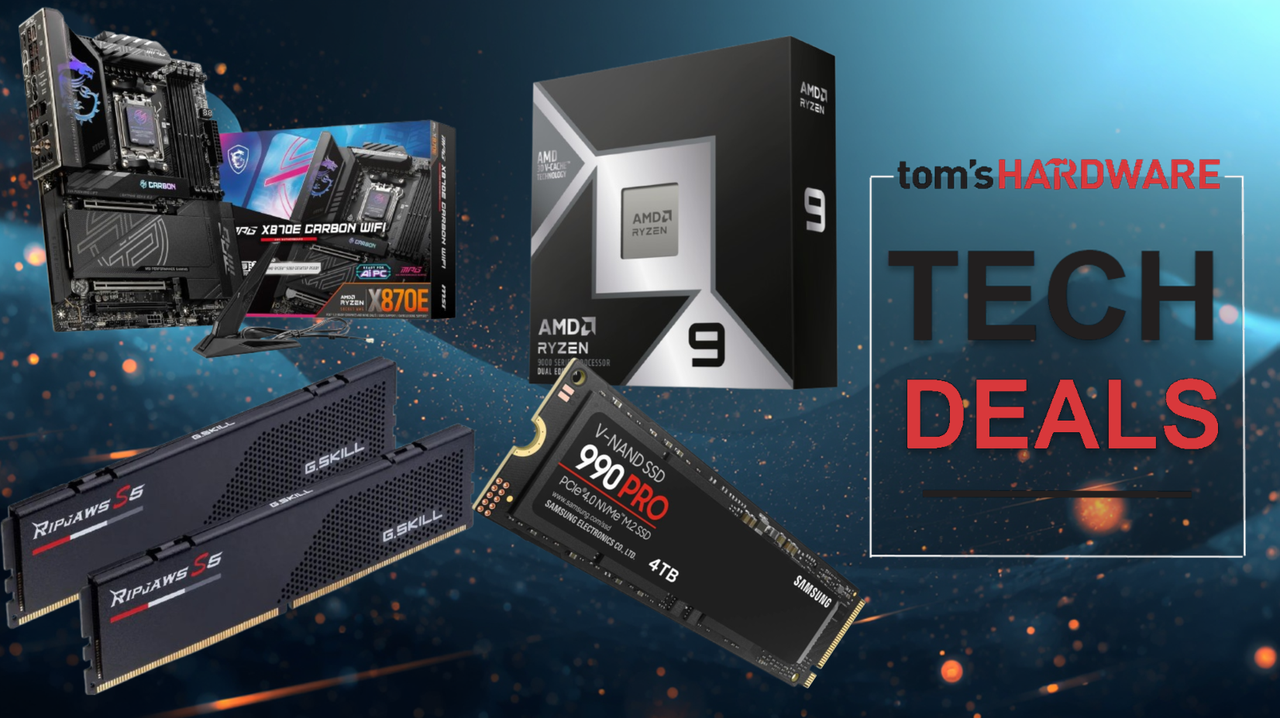
The hardware market continues to offer compelling configurations for those looking to explore or consolidate local computing capabilities, including for artificial intelligence workloads. Recently, a bundle offered by Newegg has garnered attention, presenting a combination of high-end AM5 components. This offer includes a flagship 9950X3D2 processor, 64GB of GSkill RAM, 4TB of high-speed M.2 storage, and a quality MSI motherboard, all priced at $2,269.
For organizations prioritizing data sovereignty and direct control over their infrastructure, configurations like this can serve as a starting point for development, testing, or small-scale LLM inference environments. The availability of performant hardware at defined costs is a key factor in evaluating the Total Cost of Ownership (TCO) for on-premise deployments, contrasting with the operational expenditure models typical of cloud solutions.
Technical Details and Implications for AI Workloads
Analyzing the components, the 9950X3D2 processor, while a desktop CPU, offers significant computing power that can be utilized for model orchestration, data pre-processing, and running AI workloads that do not exclusively require GPU acceleration. Its architecture is designed to handle complex tasks, making it suitable for development environments where flexibility is a priority.
The 64GB of GSkill RAM is a critical factor for running Large Language Models. Many LLMs, even quantized ones, require a significant amount of memory to load model parameters and manage context. This RAM capacity allows for hosting considerably sized models directly in memory, reducing access latency compared to storage. The 4TB of M.2 storage, known for its high speed, is essential for rapid loading of training datasets, model checkpoints, and managing generated output, minimizing I/O bottlenecks. Finally, the MSI motherboard provides the stable foundation and connectivity options necessary to support these components and future expansions.
Context for On-Premise Deployment and Data Sovereignty
While this configuration is desktop-grade, it embodies the fundamental principles of on-premise deployments valued by AI-RADAR. A self-hosted system offers complete control over the hardware and software environment, ensuring that sensitive data remains within corporate or national boundaries—a crucial aspect for compliance and data sovereignty. This approach is particularly relevant for sectors such as finance, healthcare, or public administration, where privacy regulations are stringent.
The ability to have a local development environment, even for PoCs or training smaller models, allows teams to innovate without relying on external cloud infrastructures. This can not only optimize TCO in the long run but also offers the flexibility to configure the environment specifically for one's needs, including creating air-gapped setups for maximum security.
Future Prospects for Local AI Infrastructure
The evolution of hardware continues to make the creation of local AI infrastructures more accessible. Configurations like the Newegg bundle demonstrate that it is possible to assemble performant systems for specific development and inference needs without necessarily resorting to cloud solutions for every phase of an LLM's lifecycle. The choice between an on-premise deployment and a cloud-based solution depends on a complex evaluation of factors such as scalability, operational costs, security requirements, and internal expertise.
For companies evaluating self-hosted alternatives, understanding hardware specifications and their associated trade-offs is fundamental. AI-RADAR offers analytical frameworks on /llm-onpremise to support these decisions, providing tools to compare CapEx and OpEx, evaluate performance, and ensure regulatory compliance. Investing in local hardware, while requiring internal management, can translate into greater control, cost predictability, and data security—elements increasingly central to enterprise AI strategy.





💬 Comments (0)
🔒 Log in or register to comment on articles.
No comments yet. Be the first to comment!