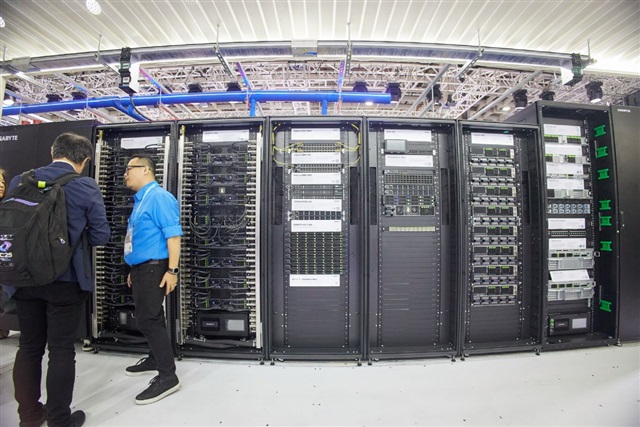
COMPUTEX and the New Era of AI Data Centers
COMPUTEX, one of the most significant global technology events, this year highlighted an emerging and disruptive trend: the shift towards prefabricated AI data centers. This evolution represents a paradigm change in how companies conceive and deploy the necessary infrastructure to support intensive artificial intelligence workloads, from training to inference.
Traditionally, data center construction is a long and complex process, requiring months or years of planning, design, and on-site realization. However, the specific demands of AI, which require extremely high computational density, advanced cooling systems, and robust power supply, are pushing the industry towards more agile and standardized solutions. Prefabricated data centers emerge as a direct response to these challenges, offering a faster and more efficient path for deploying dedicated AI capabilities.
The Evolution of Infrastructure for Artificial Intelligence
Infrastructure for artificial intelligence, particularly for Large Language Models (LLM), demands significant computational resources, often relying on a high number of GPUs. Designing environments capable of effectively hosting and cooling these configurations is complex. Prefabricated data centers, often built in standardized modules, significantly accelerate deployment times, reducing the uncertainties associated with traditional construction.
These modular solutions can be assembled and tested in a factory, then transported and rapidly installed at the final site. This not only optimizes timelines but also ensures greater consistency in infrastructure quality and performance. For companies needing to rapidly scale their AI capabilities or deploy solutions in locations with limited infrastructure, the prefabricated approach offers a significant competitive advantage.
Implications for On-Premise Deployment and Data Sovereignty
The increasing adoption of prefabricated AI data centers has profound implications for on-premise and hybrid deployment strategies. Organizations wishing to maintain full control over their data and operations, perhaps for compliance, security, or data sovereignty reasons, find these solutions a viable alternative to the public cloud. The ability to rapidly deploy self-hosted AI infrastructure, even in air-gapped environments, becomes more accessible.
From a Total Cost of Ownership (TCO) perspective, while the initial investment (CapEx) for prefabricated infrastructure can be significant, long-term benefits include reduced time-to-market, greater energy efficiency, and potentially lower operational costs (OpEx) due to standardization and ease of maintenance. For those evaluating on-premise deployment, AI-RADAR offers analytical frameworks on /llm-onpremise to assess the trade-offs between control, performance, and costs, helping to make informed decisions about their infrastructure roadmap.
Future Prospects and Strategic Trade-offs
The trend of prefabricated AI data centers, highlighted at COMPUTEX, suggests a future where artificial intelligence infrastructure will be increasingly modular, scalable, and rapid to deploy. This approach offers companies the necessary flexibility to adapt to the evolving demands of AI workloads, while ensuring the control and security required by regulated sectors or specific business strategies.
It is crucial, however, to consider the trade-offs. While prefabrication offers speed and standardization, it might limit the degree of extreme customization that some very specific applications could require. The choice between a traditional data center, a prefabricated solution, or a cloud deployment will always depend on the strategic priorities, budget constraints, and specific technical needs of each organization. The trend is clear: innovation in AI infrastructure is in full swing, with a focus on speed and efficiency.







💬 Comments (0)
🔒 Log in or register to comment on articles.
No comments yet. Be the first to comment!