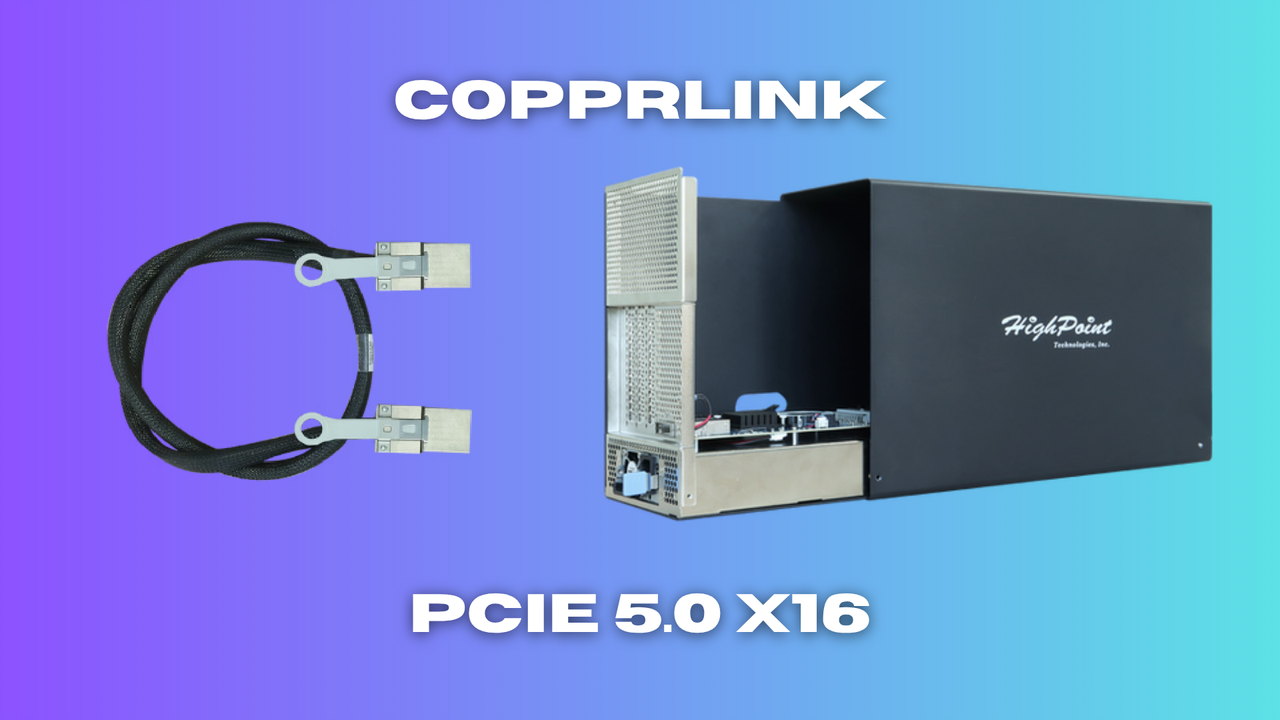
The CopprLink Ecosystem Redefines eGPU Performance
Integrating advanced computing power into local environments remains a constant challenge for infrastructure architects and CTOs. In this context, the HighPoint CopprLink ecosystem emerges with a bold promise: to surpass current eGPU (External Graphics Processing Unit) standards and deliver near-native performance. This technology aims to bridge the gap between the flexibility of external solutions and the intrinsic power of graphics cards installed directly in internal PCIe slots.
The ability to leverage high-end GPUs, such as the recent RTX 5090, in external configurations opens new perspectives for intensive workloads, including Large Language Model (LLM) Inference and Fine-tuning on workstations or compact servers. Traditionally, eGPUs have suffered from bandwidth and latency limitations, which have compromised their effectiveness in professional scenarios where every millisecond and every gigabyte of Throughput matters. CopprLink aims to address precisely these critical issues.
Technical Details and Performance Implications
According to tests, the CopprLink ecosystem, paired with an RTX 5090 GPU, managed to achieve "near-native" performance. This means the solution is capable of minimizing the communication overhead between the external GPU and the host system, a crucial factor for applications requiring high processing speed and low response time. For LLM workloads, for example, reduced latency translates into higher Token Throughput per second and a better user experience for interactive applications.
"Near-native" performance suggests that CopprLink could offer significantly higher effective bandwidth compared to eGPU solutions based on Thunderbolt or other consumer interfaces. This is fundamental for managing complex models that require rapid data transfer between the GPU's VRAM and system memory, or for distributed training scenarios where model weight synchronization is critical. The ability to fully utilize the power of a GPU like the RTX 5090, with its potential VRAM and computing capabilities, in an external format, represents a step forward for those who need flexibility without sacrificing performance.
Cost and On-Premise Deployment Considerations
CopprLink's innovation does not come without an additional cost. The setup requires an investment of $2,300 in complementary hardware. This data is crucial for decision-makers evaluating the Total Cost of Ownership (TCO) of their AI infrastructures. While the flexibility of a high-performance eGPU can reduce the need for dedicated servers or complex internal hardware upgrades, the additional cost must be carefully weighed.
For companies prioritizing On-Premise Deployment, data sovereignty, or the creation of Air-gapped environments, solutions like CopprLink can represent an interesting compromise. They allow AI workloads to be kept within their perimeter, leveraging state-of-the-art hardware without resorting to costly upgrades of entire workstations or servers, or relying on external cloud services. However, it is essential to balance the initial cost of additional hardware with the long-term benefits in terms of control, security, and local scalability.
Future Prospects for AI Infrastructure
The emergence of solutions like HighPoint CopprLink highlights a clear trend in the industry: the pursuit of high performance in more flexible and controllable formats. For CTOs and infrastructure architects, the ability to decouple computing power from the host platform offers new strategies for resource allocation and hardware lifecycle management. This is particularly relevant in a landscape where the latest generation GPUs are increasingly powerful and expensive.
The ability to easily upgrade or move graphics computing power without replacing the entire system can optimize TCO and extend the useful life of existing infrastructure. While the cloud offers on-demand scalability and flexibility, Self-hosted solutions with advanced eGPUs address the need for granular control, security, and predictable costs for specific workloads. For those evaluating the trade-offs between On-Premise Deployment and cloud, AI-RADAR offers analytical Frameworks on /llm-onpremise to support informed decisions, analyzing the constraints and opportunities of each approach.




💬 Comments (0)
🔒 Log in or register to comment on articles.
No comments yet. Be the first to comment!