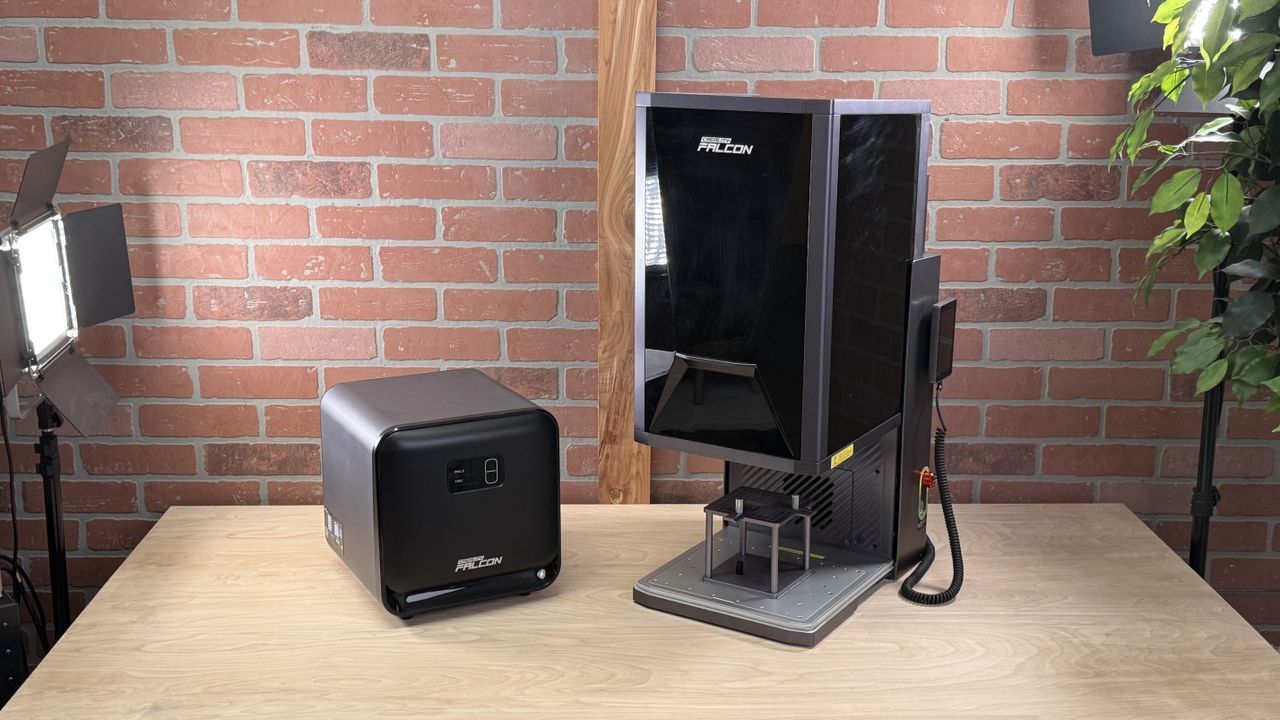
Creality picked an interesting moment to refresh its laser engraving line. The Falcon T1, recently reviewed, is not just another maker gadget—it is a manifesto of hardware modularity in a category usually dominated by monolithic machines.
Anyone who follows the evolution of personal fabrication tools knows Creality, but the Falcon T1 brings a specific idea: every key component—laser head, work bed, exhaust system—can be swapped or upgraded without discarding the whole machine. This approach, today applied to a desktop engraver, is the same one that architects of on-premise infrastructure for LLMs are beginning to take seriously.
Beyond the gadget: modular architecture and simplified maintenance
The Falcon T1’s body is designed to be open, not sealed. The laser head detaches in a few moves, and Creality offers modules with different power levels and wavelengths to shift from engraving to cutting. The practical fallout is immediate: a damaged part does not retire the entire system, and the user invests only in the upgrade that matters.
For those working on more complex systems—think multi-GPU servers for inference—the lesson is plain. In on-premise racks, a board with insufficient VRAM or a node that cannot keep up with throughput often forces a full replacement, inflating TCO. A modular design with swappable GPUs or accelerators would allow resource scaling without rebuilding the infrastructure from scratch, preserving investments in power, cooling, and networking.
Modules and control: the hardware sovereignty lever
There is another aspect that makes modularity relevant beyond the workbench. When a user can choose and replace a component directly, control over the machine shifts toward the operator. In the world of on-premise AI, this translates into the ability to selectively upgrade compute units, avoiding vendor lock-in or external procurement cycles.
In air-gapped environments or under strict data residency requirements, being able to physically intervene on hardware means maintaining sovereignty over the entire stack. Modularity thus becomes not only an economic advantage but a principle of operational autonomy.
What the Falcon T1 signals for the local AI ecosystem
The message is not that a laser engraver can replace a GPU node. The Falcon T1 review tells us rather that modular thinking, grown in the maker community, is becoming mature enough to be applied to critical systems. Seeing it in a consumer product is a signal: the supply chain can handle swappable components with decent tolerances, lowering the risk when designing hardware for on-premise LLM training or inference.
For those evaluating on-premise deployments, known trade-offs exist: modularity means additional connectors, potential points of failure, higher initial integration costs. But it also means gradually adapting to larger models or new quantization techniques without buying everything again. It is the same calculus a craftsman makes when choosing a versatile tool: pay a little more upfront, but avoid buying a new machine every two years.
The trajectory is clear: as AI workloads move on-site to satisfy privacy, latency, or cost constraints, hardware flexibility becomes a balance-sheet item. The Falcon T1, with its quiet lesson in mechanics, reminds us that sometimes the answer is not a faster box, but a box you are not forced to replace.






💬 Comments (0)
🔒 Log in or register to comment on articles.
No comments yet. Be the first to comment!