NVIDIA has brought CUDA 13.5 to general availability, alongside the Linux driver 620.70.06. The fact that Vera Rubin support enters the stable branch is not a footnote: for teams designing self-hosted GPU infrastructure, the release moves forward a phase that previously collided with waits for mature toolchains. The CUDA platform arrives before the hardware, not after. That changes the timeline for validating LLMs, inference, and training pipelines.
A platform that arrives before the hardware
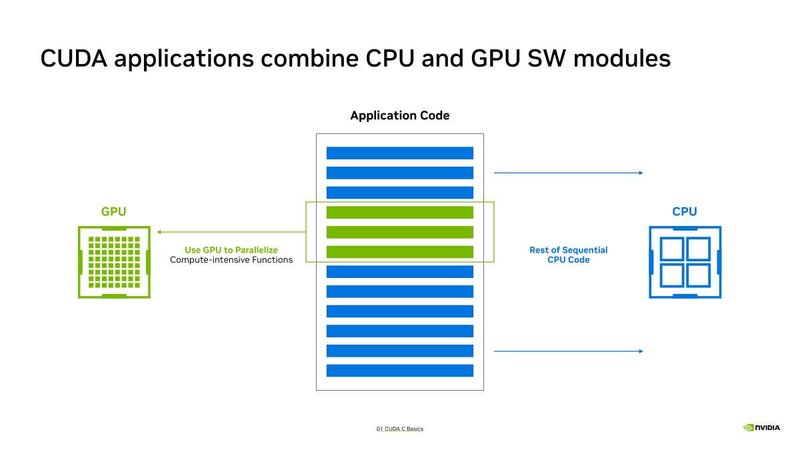
The point is not the specific version, but how NVIDIA coordinates software and hardware. Until a few years ago, production support for a new architecture often arrived close to or after the first servers became available. With CUDA 13.5, integration work — containers, serving runtimes, communication libraries, compilation pipelines — can start before data centers receive Vera Rubin nodes. This reduces operational lead time and shifts part of the project risk from the go-live phase to the preparation phase.
The immediate winners are system integrators and enterprise teams that need to keep their GPU farms running without moving to the cloud. Being able to compile, profile, and test parts of the pipeline on CUDA 13.5 means carrying fewer unknown variables when Vera Rubin servers enter the machine room. Those betting on alternative stacks face an even higher barrier: early CUDA support makes the NVIDIA ecosystem the shortest path to using the new GPUs, even when price or energy consumption differentials might suggest more open evaluations.
The TCO of self-hosted infrastructure does not depend only on the purchase cost of the nodes. It also depends on the technical time required to make the systems productive. The fact that CUDA 13.5 is already in GA moves integration costs upstream and, in many cases, reduces them: compatibility tests, memory profiles, and inference optimizations can be handled on intermediate builds, without forcing the team to stand still waiting for final hardware.
There is also a less visible second-order effect: early toolchain availability pushes server vendors and cloud providers to prepare system images well in advance, because they know customers will immediately ask for compatible environments. This shortens the time between the introduction of a new architecture and its adoption in real workloads. It is not a technical detail: it is a competitive lever affecting the replacement speed of AI infrastructure.
For organizations that do not want to move data and models to external clouds, early production support is an important condition: it reduces the operational uncertainty of adopting new hardware in environments with data residency constraints. On-premise deployment decisions still require an integrated view of these trade-offs. AI-RADAR discusses them in detail at /llm-onpremise, where the analytical frameworks for cost and data sovereignty constraints are not separated from platform choices.






💬 Comments (0)
🔒 Log in or register to comment on articles.
No comments yet. Be the first to comment!