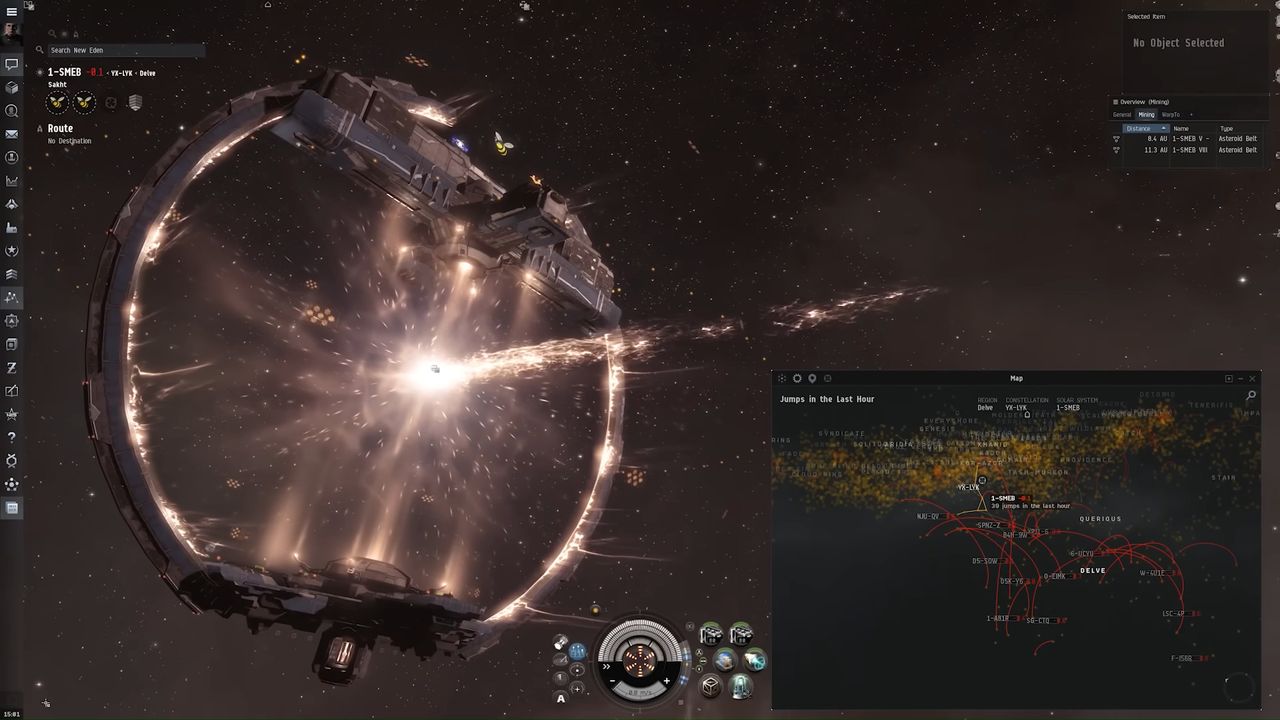
DeepMind to Train AI on Eve Online: Google Invests in Fenris Creations
Google DeepMind, Alphabet's artificial intelligence division, has announced an ambitious initiative: to train its AI systems using the complex player interactions within the renowned MMORPG Eve Online. This strategic move is accompanied by a significant investment from Google, which has acquired a minority stake in Fenris Creations, the recently independent company responsible for developing Eve Online.
The objective is to leverage the richness and complexity of data generated by hundreds of thousands of players to develop more sophisticated AI models. Eve Online is known for its player-driven economy, intricate social dynamics, and large-scale battles, making it an ideal environment for studying human behavior and emergent strategies in a dynamic and unpredictable context.
The Playing Field: Eve Online as an AI Laboratory
Eve Online stands out in the gaming landscape for its scale and the depth of its simulations. With a quarter-million active players interacting in a single persistent universe, the game generates an unprecedented amount of data on decision-making, collaboration, conflict, and economics. This makes it a natural "laboratory" for artificial intelligence research, offering a controlled yet extremely complex environment for training AI agents.
Training models on such rich game data can lead to significant advancements not only in understanding human behavior but also in developing AI capable of navigating and optimizing strategies in complex systems. The ability of an AI to learn from large-scale human interactions could have implications far beyond gaming, influencing sectors such as logistics, finance, or complex network management.
Implications for AI Infrastructure and Deployment
A project of this magnitude, involving the training of AI on a dataset as vast and dynamic as Eve Online's, raises important infrastructural considerations. Processing and analyzing data generated by a quarter-million players require substantial computing and storage resources. Companies undertaking similar initiatives must carefully evaluate deployment options, ranging from public cloud to self-hosted or hybrid solutions.
The choice between an on-premise deployment and using cloud services depends on factors such as TCO, data sovereignty requirements, and the need for direct hardware control. For intensive AI training workloads, the availability of VRAM and the throughput capacity of GPUs are critical parameters. Although the source does not specify DeepMind's deployment approach for this project, the scale of the operation highlights common challenges companies face in sizing infrastructure for training Large Language Models and other complex AI models. AI-RADAR offers analytical frameworks on /llm-onpremise to evaluate these trade-offs.
Future Prospects of AI in Gaming and Beyond
Google's investment in Fenris Creations and DeepMind's commitment to AI training on Eve Online mark a significant step at the intersection of artificial intelligence and virtual worlds. The results of this research could not only enhance the gaming experience through smarter and more responsive AI but also provide valuable insights for the development of autonomous systems in real-world contexts.
The ability of an AI to learn from complex human strategies and adapt to constantly evolving scenarios is a key frontier of research. This type of collaboration between game developers and AI leaders could accelerate the discovery of new algorithms and approaches, pushing the boundaries of what artificial intelligence can achieve, both within and outside the confines of a virtual universe.




💬 Comments (0)
🔒 Log in or register to comment on articles.
No comments yet. Be the first to comment!