The Evolution of AI Rendering with DLSS 4.5
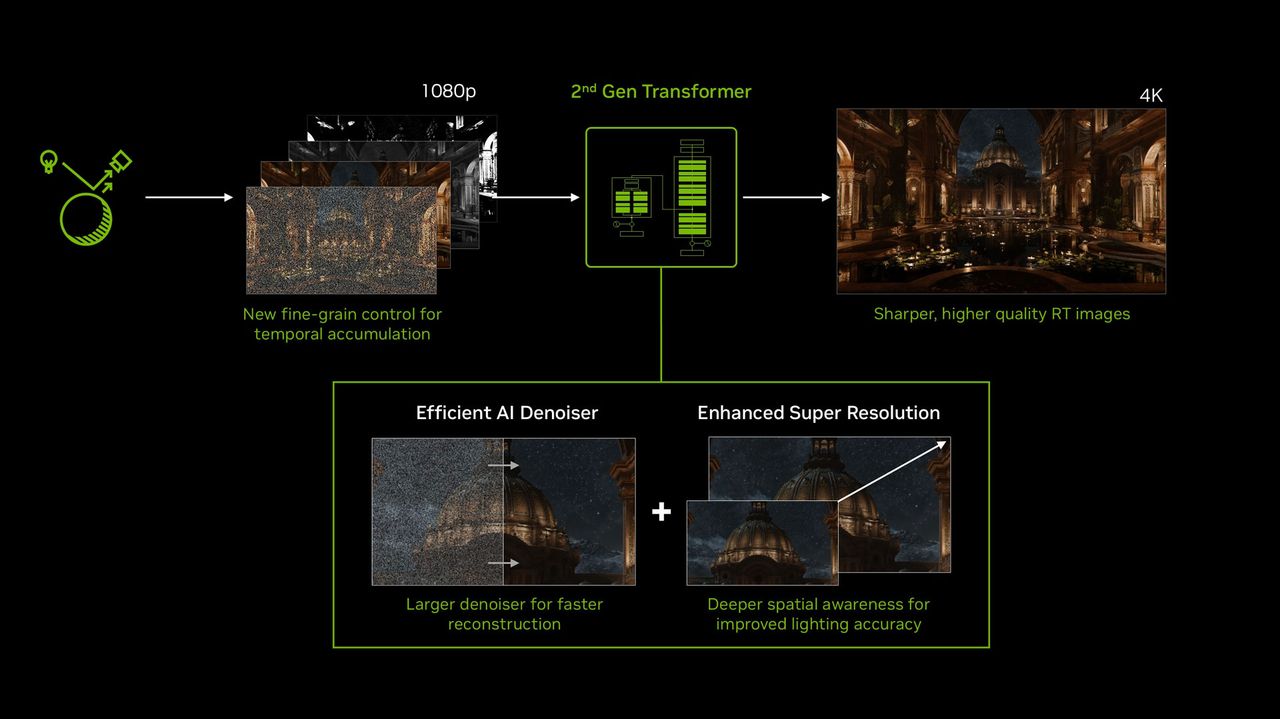
The landscape of graphics rendering continues to be shaped by artificial intelligence, with technologies like Deep Learning Super Sampling (DLSS) playing an increasingly central role. DLSS, known for its ability to enhance performance and visual quality through AI-powered upscaling, is preparing for a significant new step forward. The DLSS 4.5 Ray Reconstruction update, scheduled for release in August, aims to further refine the ray tracing experience, an area notoriously demanding in terms of computational resources.
The primary goal of this new iteration is to ensure superior visual quality for ray-traced scenes, delivering sharper and more detailed images. This development underscores how AI is no longer confined to specific domains but is permeating every aspect of digital processing, from scientific computing to interactive graphics.
Transformer Architecture and Training Data: Pillars of Innovation
At the core of the DLSS 4.5 Ray Reconstruction update are two fundamental technical elements: a broader training data set and the adoption of a second-generation transformer architecture. These components are crucial for the operation of any artificial intelligence model, and their direct evolution translates into tangible improvements in system capabilities.
A more extensive training data set allows the AI model to learn from a wider variety of visual scenarios and patterns. This results in an improved ability to reconstruct complex details, manage the nuances of light and shadow, and reduce visual artifacts that can emerge in intensive ray tracing environments. The second-generation transformer architecture, on the other hand, represents an optimization of the model itself. Transformers are the frameworks underlying Large Language Models (LLM) and many other advanced AI applications, known for their efficiency in processing complex sequences and contexts. A second-generation version implies improvements in computational efficiency, inference accuracy, or the ability to handle more complex inputs, leading to more faithful and realistic visual results.
Implications for Infrastructure and AI Workloads
Although DLSS is a consumer-oriented technology, its technical foundations have direct implications for IT professionals and companies managing AI workloads. The adoption of advanced transformer architectures and the reliance on massive training datasets for graphics rendering highlight a general trend: AI workloads increasingly demand computational power and specialized infrastructure for efficient inference.
For CTOs, DevOps leads, and infrastructure architects, this means carefully evaluating the hardware needed to support complex AI models. GPUs with high VRAM and significant throughput capabilities become essential not only for training but also for the inference phase, where latency is critical. Total Cost of Ownership (TCO) considerations for self-hosted or on-premise deployments become central: the initial investment in performant silicon can offer long-term benefits in terms of data control, sovereignty, and operational costs compared to cloud solutions for intensive and predictable AI workloads. AI-RADAR offers analytical frameworks on /llm-onpremise to evaluate these trade-offs and support informed decisions.
The Future of AI Across Rendering and Enterprise Applications
The convergence of artificial intelligence and advanced graphics, exemplified by DLSS 4.5 Ray Reconstruction, is a clear indicator of how AI is transforming diverse sectors. The continuous evolution of models like transformers and the optimization of training and inference processes represent constant challenges for the technology industry. The ability to process and reconstruct complex information with greater fidelity and efficiency is a transversal requirement, applicable to rendering a video game as much as to analyzing critical data in an enterprise environment.
For companies developing or deploying AI solutions, understanding these innovations is not just a matter of technological curiosity but a strategic factor. Decisions on infrastructure, the choice between on-premise and cloud deployment, and cost optimization depend on a deep understanding of the capabilities and requirements of the latest AI architectures. Progress in areas like DLSS provides further confirmation of the direction in which the entire artificial intelligence ecosystem is moving.



💬 Comments (0)
🔒 Log in or register to comment on articles.
No comments yet. Be the first to comment!