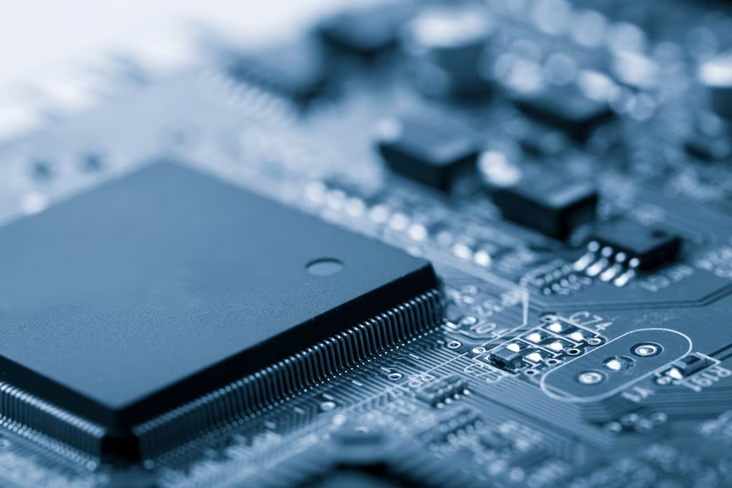
For months analysts have been watching Asia’s manufacturing sector, wondering whether the post-pandemic recovery would hold. In June, the answer came with a clear stamp: artificial intelligence. Chips, servers, and data-center equipment kept order books full, partially offsetting a slowdown in other industries. Purchasing Managers’ Index (PMI) survey data published this week show robust growth in the tech segment, but the overall picture is darkened by a geopolitical factor: the Iran war. The intensifying conflict is already pushing up energy costs and lengthening shipping routes across the region – a knot that affects both producers and buyers of AI hardware.
Asia’s factories, the beating heart of global electronics supply, now face a double squeeze: accelerating orders for compute infrastructure on one side, rising electricity tariffs and maritime freight rates on the other. Those who follow the Large Language Models (LLM) market know that the entire supply chain – from GPUs to HBM memory, from servers to cooling equipment – is concentrated in a few regional hubs. Any bottleneck directly feeds into the availability of machines for inference and training, activities that in on-premise scenarios require specific hardware, often ordered months in advance.
For organizations evaluating self-hosted deployments – driven by data sovereignty needs, operational cost control, or compliance with regulations like GDPR – this news sounds an alarm. GPU and bare-metal procurement lead times could lengthen further, while energy costs eat into operational budgets. This is far from trivial: the TCO (Total Cost of Ownership) of an on-premise LLM cluster depends heavily on capital cost (CapEx) and the energy consumed over the machine’s lifetime. Delivery delays and electricity price hikes can tip the business case, making some cloud offerings more competitive even for workloads that firms would prefer to keep in-house.
Yet AI hardware demand shows no sign of slowing. The paradox is that geopolitical tensions and logistical bottlenecks are accelerating the quest for technological independence. Companies and governments alike are showing growing interest in building up local compute capacity to avoid getting trapped in increasingly fragile supply chains. This trend is not limited to hyperscalers filling data centers; it also touches medium-sized enterprises starting to explore fine-tuning of models on a smaller scale but with proprietary data.
In this landscape, the ability to read signals from Asian markets becomes a strategic skill. A single month of production more or less at Taiwanese foundries or Southeast Asian assembly plants can mean the difference between an on-time deployment and a delayed project. AI-RADAR will keep monitoring supply chain evolution because, when it comes to on-premise AI, the first link in the chain is often the last to be considered, yet it determines everything else.




💬 Comments (0)
🔒 Log in or register to comment on articles.
No comments yet. Be the first to comment!