Consumer GPUs were never designed to coexist in spaces conceived for traditional gaming. Yet when a Reddit user posts a photo of their Thermaltake Core P3 with two RTX 3090s squeezed against a radiator tilted by a 3D-printed bracket, the line between aesthetic modding and local AI inference becomes razor-thin. The caption — "qwen 27b go brrrrr" — says it all: this build is meant to run a 27-billion-parameter LLM without touching the cloud.
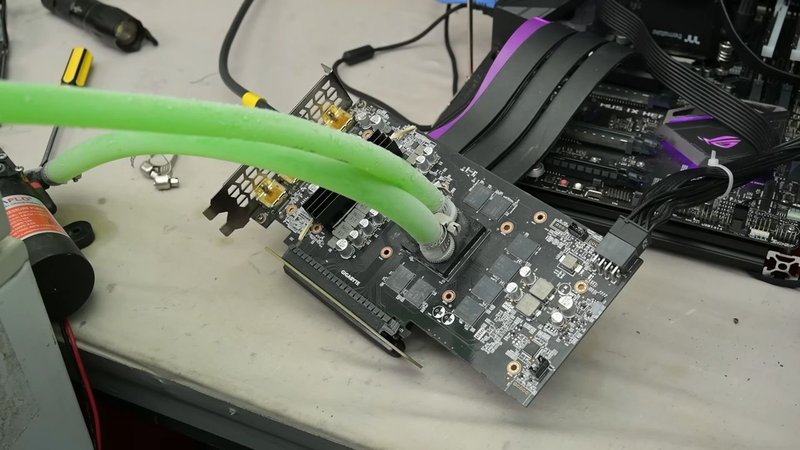
The Thermaltake Core P3 is an open-frame case, made to show off components and simplify liquid cooling. But dual RTX 3090s occupy a footprint that, with a conventionally mounted radiator, simply isn’t there. Hence the workaround: a filament-printed bracket that angles the radiator just enough to free the needed millimeters. The DIY community has crossed gaming hardware and AI workloads before, but this build has the merit of making visible — literally — how local inference is becoming a practice within reach of savvy enthusiasts.
Why two 3090s specifically
The bet on RTX 3090s hinges on VRAM. Each card offers 24 GB, totaling 48 GB when paired. A 27-billion-parameter model in FP16 would require roughly 54 GB, too much for two 3090s. But apply 4-bit quantization, and the requirement drops below 14 GB, easily manageable on a single card. If the user is employing both GPUs, they are likely splitting the load via tensor parallelism or running at mixed precision to cut latency. In any case, the implicit message is that 48 GB of combined memory opens the door to mid-sized models — Qwen 27B, Mistral 8x7B, quantized LLaMA 3 70B — without needing enterprise hardware.
From a TCO standpoint, two used 3090s cost far less than a single A100 or H100 today, while still providing significant compute power. True, the 3090s lack NVLink, and inter-GPU communication goes through PCIe, adding latency under bus-saturating loads. But for the small-batch inference typical of personal use or a small team, the penalty is more theoretical than real. And data sovereignty — no prompt ever leaves the machine — is a clear win.
Modding as an on-premise enabler
The interesting part isn’t purely technical: it’s cultural. Having to physically adapt a case signals that consumer hardware isn’t yet designed for multi-GPU AI scenarios. Yet the community responds with 3D printing, radiator offsets, and tinkerer patience. It’s the same spirit that pushed early crypto miners to build open rigs, and that today fuels an ecosystem of self-hosted LLM solutions.
For those evaluating on-premise deployment, this story offers two practical takeaways. First, 3090s remain a sweet spot between cost and VRAM capacity, ideal for exploring partial fine-tuning or inference on medium-to-large models without renting cloud GPUs. Second, physical assembly is no minor detail; cases, power supplies, and cooling must be rethought, sometimes through creative solutions like custom brackets. AI-RADAR closely tracks the implications of such choices, particularly around thermal management and long-term reliability — two factors that in an enterprise setting can separate a working prototype from a stable service.
The final image — two cards almost touching and the radiator set at a slant — is a snapshot of a transitional moment: generative AI is leaving data centers and carving out space inside cases built for gaming, helped by a dose of ingenuity. Perhaps, a few years from now, we’ll look back at these DIY builds as the early signs of an on-premise LLM infrastructure still taking shape.




💬 Comments (0)
🔒 Log in or register to comment on articles.
No comments yet. Be the first to comment!