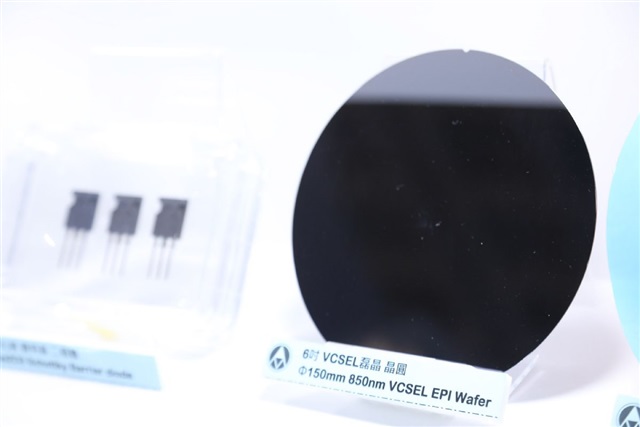
Episil and the Acceleration in Silicio Photonics
The global artificial intelligence landscape continues to push the boundaries of hardware innovation, with key companies investing heavily to meet growing computing demands. In this context, Episil, a prominent Taiwanese wafer manufacturer, has announced a significant strategic move: tripling its capital expenditure (capex). The stated goal of this substantial funding is to expand production capabilities and research and development in silicio photonics, a technology considered crucial for the future of AI.
This decision underscores the understanding that the evolution of Large Language Models (LLM) and other AI workloads requires not only increased computing power but also advanced solutions for data management and energy efficiency. Episil's investment positions itself as an indicator of the direction the semiconductor industry is taking to address the challenges posed by the next generation of AI systems.
Silicio Photonics: A Pillar for High-Performance AI
Silicio photonics represents a cutting-edge technology that integrates optical components (such as lasers, modulators, and photodetectors) directly onto a silicio chip. This approach allows for the use of light, rather than electrons, for data transfer, offering substantial advantages in terms of speed, bandwidth, and power consumption. For AI workloads, particularly for large-scale LLM Inference and training, the ability to move vast amounts of data between GPUs, memories, and compute nodes with minimal latency and maximum efficiency is fundamental.
The adoption of silicio photonics can drastically improve interconnects within data centers and between chips, overcoming the physical and energy limitations of traditional electrical copper connections. This translates into higher throughput and a significant reduction in power consumption, critical factors for the sustainability and scalability of AI infrastructures. The technology is seen as a key enabler for distributed computing architectures and for the integration of next-generation high-bandwidth memories (HBM).
Implications for On-Premise Deployments and TCO
For companies evaluating on-premise deployments of AI workloads, the advancement of silicio photonics has direct and significant implications. The ability to build local infrastructures with faster and more efficient interconnects means achieving performance comparable to or even superior to cloud offerings, while maintaining full control over data and security. This is particularly relevant for sectors with stringent data sovereignty and compliance requirements, where air-gapped or self-hosted solutions are preferred.
An infrastructure based on silicio photonics can contribute to reducing the Total Cost of Ownership (TCO) in the long term for on-premise deployments. While the initial hardware investment may be high, savings from lower power consumption, higher compute density, and reduced cooling needs can offset the upfront costs. For those evaluating on-premise deployments, AI-RADAR offers analytical frameworks on /llm-onpremise to assess the trade-offs between performance, costs, and control, highlighting how hardware efficiency is a determining factor.
Future Outlook and Challenges in the AI Hardware Landscape
Episil's investment in silicio photonics reflects a broader trend in the semiconductor industry towards integrating optical technologies to overcome current bottlenecks. While silicio photonics offers enormous potential, its widespread adoption still faces challenges, including production costs, integration complexity, and the need for standardization. However, the commitment of players like Episil indicates a clear direction towards the maturation of this technology.
The future of AI hardware will increasingly depend on the ability to innovate not only at the processor level but also in interconnection and memory technologies. Silicio photonics is poised to play a crucial role in enabling the next generation of AI supercomputers and data centers, providing the bandwidth and efficiency needed to power increasingly complex models and support the expansion of AI deployments across all industries.






💬 Comments (0)
🔒 Log in or register to comment on articles.
No comments yet. Be the first to comment!