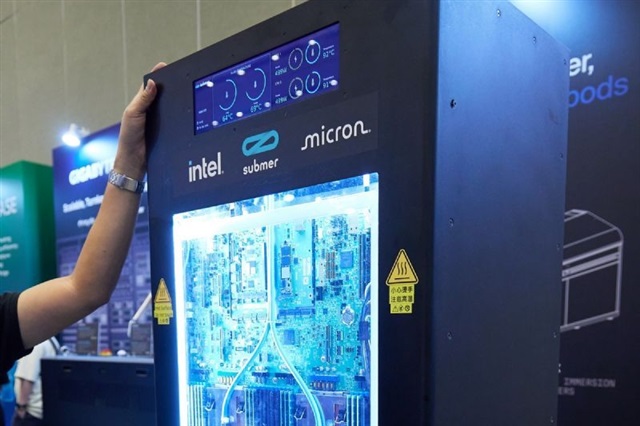
AI Demand Drives Record Revenue for Cooling Suppliers
The artificial intelligence sector continues to generate ripple effects across the entire technology supply chain. A clear example comes from Taiwan, where cooling system suppliers reported record revenues in March. This significant growth is directly attributable to the surge in demand for AI infrastructure, particularly for liquid cooling solutions, which are increasingly indispensable for managing the thermal loads generated by modern AI accelerators.
The expansion of computational capabilities required for training and inference of Large Language Models (LLMs) is putting pressure on traditional heat dissipation systems. Latest-generation GPUs, the beating heart of these systems, consume increasing amounts of power and consequently generate significant heat, making cooling a critical factor for reliability and performance.
The Crucial Role of Liquid Cooling in AI Infrastructure
Hardware architectures dedicated to AI, such as those based on high-performance GPUs, present extremely stringent thermal requirements. Components like NVIDIA H100 or A100 GPUs, with their high VRAM capacities and ability to process enormous data volumes, can generate hundreds of watts of heat each. Traditional air cooling systems struggle to effectively dissipate this heat in high-density environments, limiting the scalability and energy efficiency of data centers.
Liquid cooling offers a more efficient solution, allowing for higher power density per rack and better management of operating temperatures. This translates into greater system stability, longer component lifespan, and the ability to operate GPUs at higher frequencies, maximizing throughput. The adoption of these technologies is no longer an option but a necessity for anyone looking to build or expand cutting-edge AI infrastructures.
Implications for On-Premise Deployments and TCO
For CTOs, DevOps leads, and infrastructure architects evaluating on-premise deployments of AI workloads, the choice of cooling system has significant implications. Integrating liquid cooling requires careful planning of data center infrastructure, including liquid distribution systems, pumps, and heat exchangers. While the initial investment (CapEx) may be higher than air-based solutions, the benefits in terms of energy efficiency and density can lead to a more favorable TCO (Total Cost of Ownership) in the long run.
The ability to host more computing power in a smaller footprint, combined with potential reductions in energy-related operational costs, makes liquid cooling a key element for those seeking data sovereignty and complete control over their AI resources. For those evaluating the trade-offs between self-hosted and cloud solutions, AI-RADAR offers analytical frameworks on /llm-onpremise to delve deeper into these considerations.
The Future of AI Infrastructure is Liquid
The revenue growth of liquid cooling suppliers in Taiwan is a clear indicator of an irreversible trend in the AI sector. As models become larger and more complex, and the demand for computing capacity continues to rise, thermal management will increasingly become a differentiating factor for infrastructures. Companies investing in advanced cooling solutions will be better positioned to scale their AI operations, ensuring optimal performance and operational sustainability.
This trend underscores how innovation in AI is not limited to algorithms or chips but extends to every component of the physical infrastructure. Liquid cooling, once a niche, is rapidly becoming a de facto standard for next-generation data centers dedicated to artificial intelligence, in both cloud and on-premise environments.







💬 Comments (0)
🔒 Log in or register to comment on articles.
No comments yet. Be the first to comment!