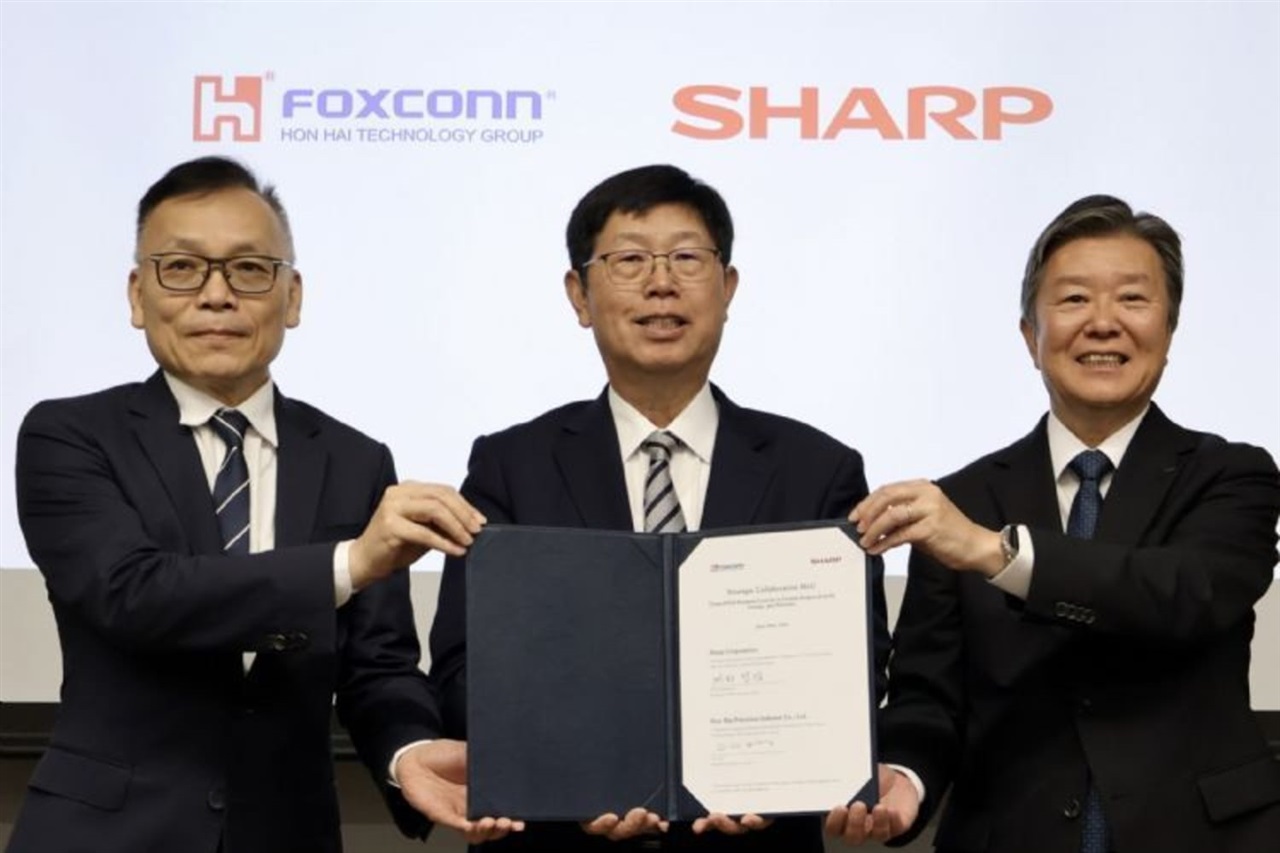
The joint move by Foxconn and Sharp is about more than two electronics titans. The just-signed strategic agreement, prioritizing AI servers and smart infrastructure, comes as the hunger for compute to run Large Language Models is reshaping the entire hardware supply chain. And it’s a signal that resonates beyond manufacturing: what does it mean for those evaluating on-premise deployments?
The announcement and its backdrop
According to DIGITIMES, Foxconn and Sharp have inked a strategic pact that shines a spotlight on two areas: servers purpose-built for artificial intelligence, and smart infrastructure. It’s not the first collaboration between the two companies — Foxconn has controlled Sharp since 2016 — but formalizing this focus marks a shift in intensity. AI hardware, especially the kind used for inference and training of LLMs, is becoming a battleground not just for chip designers but for the whole assembly and integration ecosystem.
Foxconn, the world’s largest contract electronics manufacturer, already has a significant footprint in server production for major cloud players. Sharp, for its part, brings expertise in components and consumer electronics, as well as technologies for edge and IoT. A joint priority on AI servers could thus translate into greater production capacity for systems designed to run LLM workloads locally.
From manufacturing to AI
Giving priority to AI servers is no coincidence. The explosive growth of generative models has strained the availability of hardware that can deliver inference with acceptable latency and without compromising privacy. High-end GPUs and custom accelerator architectures have become scarce resources. That’s where a player with Foxconn’s industrial scale can make a difference: scaling up production of AI-optimized servers means chipping away at the bottlenecks that currently limit many on-premise projects.
Nor should smart infrastructure be overlooked. Sharp, with its legacy in displays and sensors, could contribute to hybrid solutions where local edge computing integrates with central servers. For an enterprise weighing an on-premise deployment of LLMs, the pairing of centralized servers with edge nodes for distributed processing is a classic blueprint for keeping data in-house without sacrificing responsiveness.
AI hardware on-premise: the availability crunch
For those chasing the self-hosted path, the Foxconn-Sharp pact touches a raw nerve. Choosing to bring an LLM on-premise — for digital sovereignty, GDPR compliance, or simple operational control — often collides with two obstacles: difficulty sourcing the necessary hardware and high upfront capital costs. When supply agreements and production volumes are dominated by large cloud providers, enterprise clients that want to build private datacenters struggle to secure AI-ready servers in sufficient quantities.
If an initiative like Foxconn and Sharp’s materializes into dedicated production lines, it could broaden the supply of machines aimed at the enterprise market, not just hyperscalers. This doesn’t solve the per-GPU price problem, but it can smooth procurement, especially for standardized rack configurations built around NVIDIA, AMD accelerators or custom-designed chips.
Implications for local LLM deployment
For an IT decision-maker, it’s not just about having more servers to choose from. The Foxconn-Sharp pact signals an industry tilt toward hardware supply less tethered to purely cloud-native logic. In an on-premise deployment context, this could benefit long-term TCO: if the market becomes more competitive and less concentrated, purchase and maintenance costs may trend downward. Moreover, systems purpose-built for AI can incorporate thermal, networking, and storage optimizations that simplify the management of complex inference and fine-tuning pipelines.
True, running LLMs on-premise requires in-house expertise to orchestrate infrastructure, handle model quantization to fit available VRAM, and maintain adequate performance. But the availability of integrated hardware bundles from a stable supply chain lowers the entry barrier. For anyone dealing with data that must never leave the corporate perimeter, knowing that top-tier manufacturers are betting on AI servers is reassuring.
Smart infrastructure and the supply chain’s future
The deal’s second pillar, smart infrastructure, broadens the lens to a wider ecosystem. Smart cities, automated factories, sensor networks — all these domains will generate data that needs to be processed locally with AI models. From a sovereignty standpoint, there’s no guarantee that such processing should flow through the public cloud. Having AI servers on-site along with connected edge nodes means analyzing sensitive data in real time without moving it elsewhere.
Foxconn and Sharp are not the only companies moving in this direction, but their scale and vertical integration act as a force multiplier. The freshly signed agreement, while still lacking specifics on timelines and volumes, should be read as a piece of the larger puzzle of reshoring AI infrastructure. It’s a puzzle we follow closely at AI-RADAR, because it directly touches the choices of those building local LLM stacks who want to retain control, performance, and economic predictability.




💬 Comments (0)
🔒 Log in or register to comment on articles.
No comments yet. Be the first to comment!