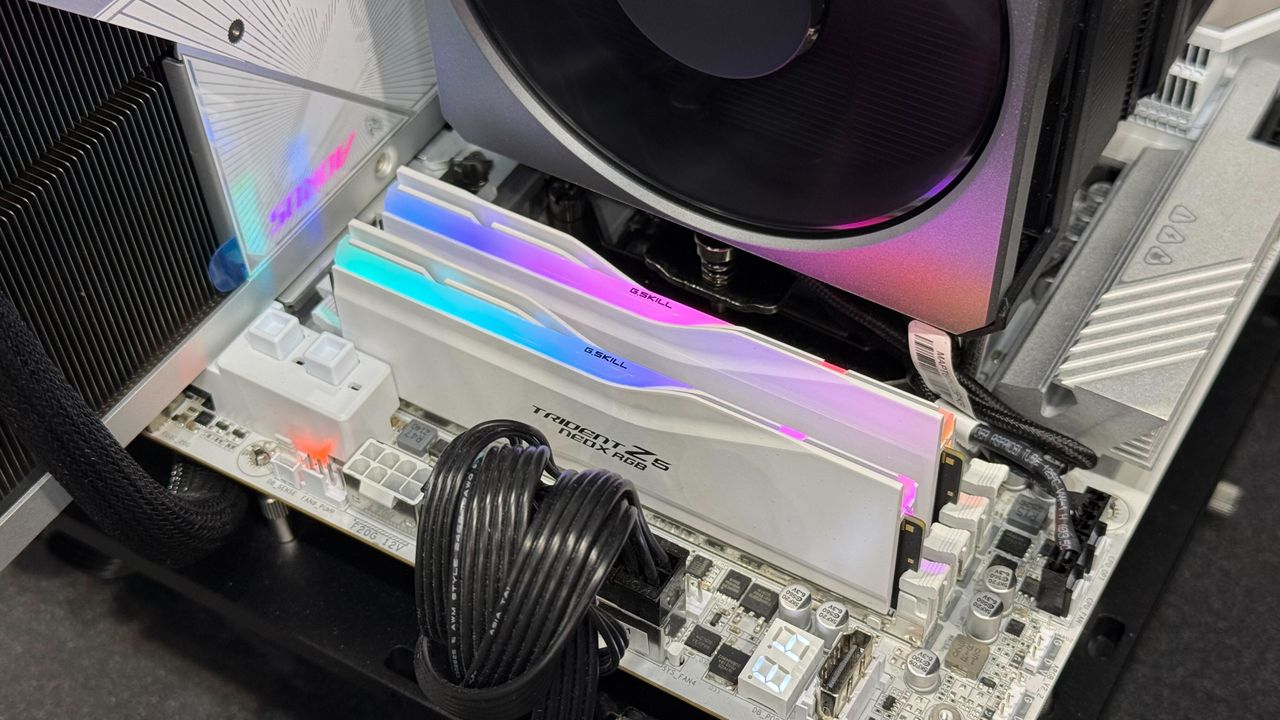
G.Skill and AMD EXPO ULL Innovation for Memory Performance
G.Skill, a renowned manufacturer of high-performance memory modules, has recently provided details on AMD EXPO ULL (Unified Low Latency) technology. This initiative aims to enhance RAM performance through a more granular approach to configuration. The goal is to allow memory module manufacturers to integrate, for the first time, subtiming tweaks directly into expanded memory profiles.
Traditionally, predefined memory profiles offer a good balance between stability and performance. However, for the most demanding workloads, every millisecond of latency and every megabyte per second of throughput matters. The introduction of profiles with customizable subtimings represents a significant step forward for those looking to extract maximum potential from their hardware.
Technical Detail: Subtimings and Performance Impact
Memory subtimings are extremely fine configuration parameters that control the internal behavior of RAM modules, directly influencing latency and throughput. While primary timings (such as CL, tRCD, tRP, tRAS) are widely known, subtimings operate at an even deeper level, optimizing access cycles and internal operations of the memory controller.
The ability to include these tweaks in AMD EXPO ULL's expanded profiles means users can benefit from advanced optimizations without resorting to complex manual adjustments in the BIOS. For applications heavily reliant on data access speed, such as Large Language Models (LLM) during Inference or Training, faster and more responsive RAM can translate into a tangible increase in tokens per second or a reduction in training times. This is particularly true for models that require loading large amounts of data or parameters into VRAM and system RAM.
Implications for On-Premise AI Workloads
For companies opting for on-premise LLM and AI deployments, hardware optimization is a top priority. The choice of a self-hosted infrastructure is often driven by data sovereignty requirements, regulatory compliance, or the need to maintain complete control over the environment. In this context, maximizing the performance of every component, from GPU to CPU to RAM, becomes crucial to justify the Total Cost of Ownership (TCO) and compete with the elasticity and scalability of cloud solutions.
Improving memory latency and throughput through technologies like AMD EXPO ULL can have a direct impact on operational efficiency. An optimized RAM system can process more data in less time, reducing waiting times for end-users or accelerating development cycles for Machine Learning teams. This is critical for air-gapped scenarios or bare metal infrastructures where every resource must be utilized to its fullest. For those evaluating on-premise deployments, AI-RADAR explores analytical frameworks on /llm-onpremise to assess trade-offs between performance, cost, and control.
Future Prospects and Trade-offs in Hardware Optimization
G.Skill and AMD's initiative with EXPO ULL underscores the continuous pursuit of performance in the hardware sector. While subtiming optimization can offer incremental gains, these accumulate to create a significant competitive advantage, especially in environments where the workload is intensive and constant. The standardization of such profiles simplifies the process for end-users, democratizing access to performance previously reserved for expert overclockers.
However, it is important to consider the trade-offs. Aggressive optimization may sometimes require greater attention to system stability and compatibility between various components. The choice between standard profiles, EXPO ULL, or manual adjustments will depend on the specific workload requirements, budget, and available expertise. For tech decision-makers, understanding these nuances is essential to building a robust, efficient, and strategically aligned AI infrastructure.






💬 Comments (0)
🔒 Log in or register to comment on articles.
No comments yet. Be the first to comment!