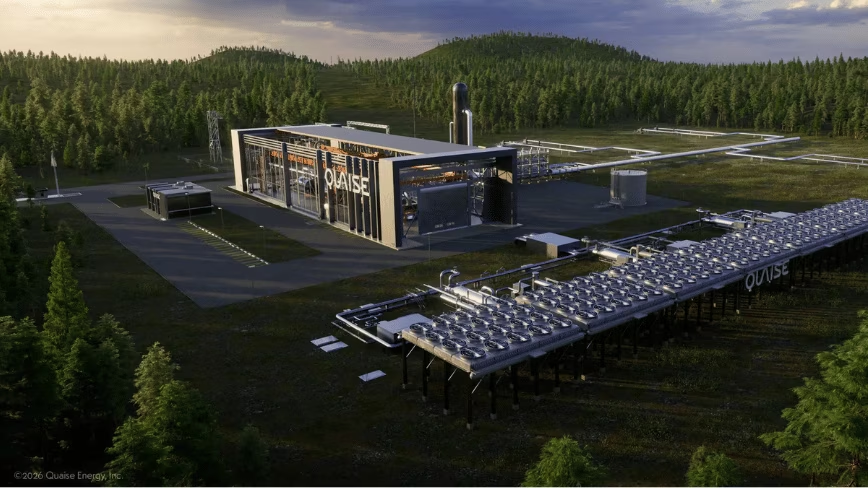
The announcement is one that catches attention even beyond the tight energy circle: Quaise Energy has raised $134 million in a Series B round led by Prelude Ventures, aiming to drill much deeper into the Earth’s crust than ever before with traditional geothermal techniques. The difference lies in the method: no mechanical drill bits wearing down against scorching granite, but microwaves capable of shattering superhot rock without direct contact. The goal is to reach depths where natural heat exceeds 400 °C, turning each well into a compact, perpetual baseload power plant.
For those managing on-premise AI infrastructure, the news is not a simple geological curiosity. Local deployment of Large Language Models and sustained inference workloads is running into an increasingly tight bottleneck: energy. Power and cooling costs feed directly into TCO, and grid volatility — particularly in Europe — pushes engineers to seek continuous solutions that go beyond the classic UPS. A scalable deep geothermal source promises exactly what is missing: stable, predictable, emission-free power, available 24/7 without dependence on gas or weather whims.
The link to the datacenter world is not forced. Large cloud operators already sign power purchase agreements with geothermal plants, but the technology remains confined to a few geologically blessed regions. Quaise shifts the perspective because, by drilling kilometers down, it aims to tap heat available almost anywhere. If the microwave approach proves commercially scalable, the architecture of distributed compute networks could receive a jolt: today, those deploying on-premise racks in urban or industrial areas often struggle with grid connection limits and transformation costs; tomorrow, a deep borehole could become a local energy asset capable of sustaining high-density GPU clusters without stressing the external grid.
There is also a sovereignty dimension. An organization that controls its own energy source — coupling a geothermal well with its data center — reduces exposure to electricity markets and grid regulators. For sensitive workloads where data residency and operational continuity are strict regulatory constraints, on-site generation-to-consumption coupling reinforces the autonomy posture. Not surprisingly, in discussions about air-gapped environments and deployments in regulated sectors, dedicated energy availability is frequently cited among the key architectural requirements.
Of course, the road ahead remains long. Field tests of microwave drilling are ongoing, and the engineering needed to bring fluids to the surface at such temperatures involves non-trivial materials and thermodynamic cycles. Still, the capital injection signals that investors see in the crust’s extreme heat not just a decarbonization answer, but an infrastructural building block for the next wave of distributed computing capacity. Those designing on-premise LLM deployments today would do well to pay close attention: the energy game has just entered a phase where depth — literally — could make the difference.







💬 Comments (0)
🔒 Log in or register to comment on articles.
No comments yet. Be the first to comment!