
Gigabyte: New Infinity Lines for 40th Anniversary, Featuring Motherboards and GPUs
On the occasion of its 40th anniversary, Gigabyte has unveiled its new range of Infinity-branded products. The announcement includes several innovations, from flagship motherboards to graphics solutions, highlighting the company's commitment to hardware innovation.
The offering focuses on key components for building high-performance systems. While not explicitly aimed at the artificial intelligence world, these products form the foundational infrastructure upon which many self-hosted solutions for intensive computational workloads, including those related to Large Language Models (LLMs), are built.
Technical Details and Infrastructure Implications
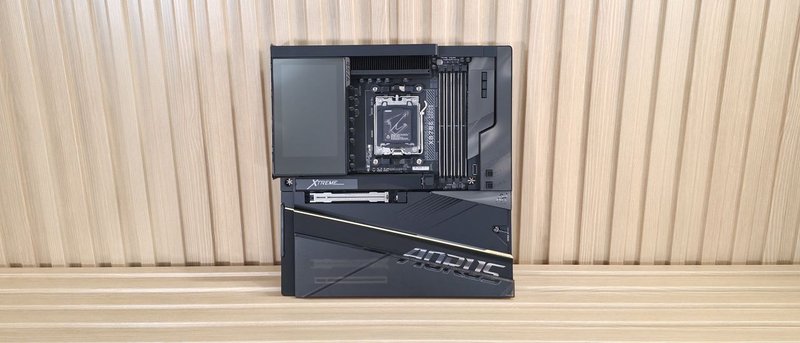
Among the new products, the X870 Infinity Next motherboard stands out, presented as a "halo motherboard." This solution is distinguished by the integration of metal 3D-printed elements, a detail that underscores Gigabyte's attention to design and advanced engineering. Alongside this, the company also showcased the Aero Wood boards, now available in a darker color, and the MicroATX Stealth boards, designed for those seeking a clean aesthetic and simplified cable management.
A particularly relevant aspect for the AI-RADAR ecosystem is the extension of Infinity-style GPUs across different tiers of the product catalog. Graphics cards are the beating heart of systems dedicated to LLM Inference and Fine-tuning. For those evaluating an on-premise deployment, the availability of GPUs with varying capabilities and costs is fundamental for balancing performance and TCO. Factors such as VRAM quantity, memory bandwidth, and compute capability are crucial for determining a system's efficiency in handling complex models, especially when considering techniques like Quantization to optimize resource usage.
The On-Premise Context and Data Sovereignty
The introduction of new hardware options by manufacturers like Gigabyte fuels the market for self-hosted solutions, offering CTOs and infrastructure architects more choices. The ability to select specific components and assemble custom servers is a fundamental pillar for those prioritizing data sovereignty, regulatory compliance, and security in air-gapped environments.
An on-premise deployment allows for granular control over the entire LLM development and deployment pipeline, from the training phase to Inference. This approach can lead to a more advantageous TCO in the long run compared to the operational costs (OpEx) of cloud services, especially for predictable, high-volume workloads. The availability of a wide range of GPUs, from high-end solutions to more accessible ones, allows for scaling infrastructure according to specific needs, optimizing investments. For those evaluating on-premise deployments, analytical frameworks are available on /llm-onpremise that can help assess the trade-offs between costs, performance, and security requirements.
Future Perspectives and Trade-offs
Innovation in the hardware sector is a continuous process, and presentations like Gigabyte's highlight the market's dynamism. For technical decision-makers, the challenge is not just identifying the most powerful components, but those best suited to their operational and strategic needs. The choice between different motherboards and GPUs involves a careful evaluation of factors such as the number of PCIe slots, power delivery capacity, connectivity options, and, of course, the specifications of the GPUs themselves.
There is no single “best” solution; rather, there are trade-offs to consider. A system with multiple mid-range GPUs might offer similar overall throughput to a few very high-end GPUs, but with different initial TCO and cooling requirements. Gigabyte's ability to extend its GPU offerings across various market segments provides flexibility, allowing companies to build scalable and resilient infrastructures while maintaining control over their data and operational costs.






💬 Comments (0)
🔒 Log in or register to comment on articles.
No comments yet. Be the first to comment!