Gigabyte's Innovation for Edge AI at Computex 2026
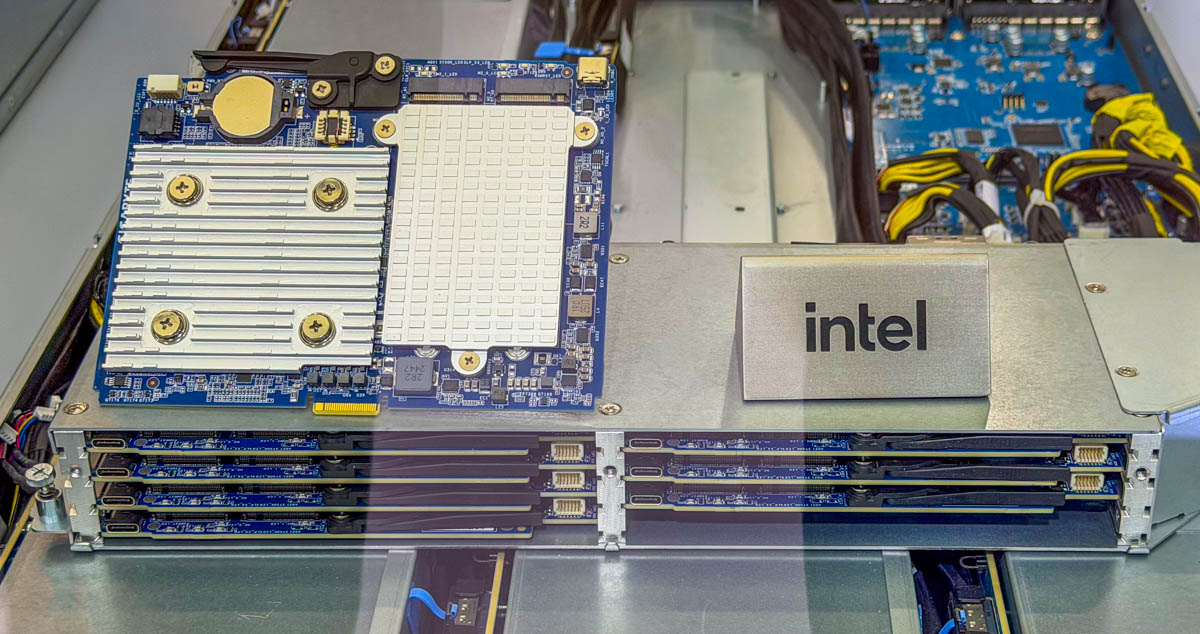
At Computex 2026, Gigabyte captured attention with its R1C7-K0A-AS1 cluster, a proposition that redefines the concept of computational density. This solution, housed within a 1U rack unit, is designed to accommodate an impressive 40 independent nodes. Such a compact architecture proves particularly appealing for companies looking to deploy AI processing capabilities directly on-site, reducing physical footprint and optimizing space utilization in data centers or edge environments.
The unveiling of such a dense system underscores a growing trend in the industry: the necessity to bring artificial intelligence closer to the data source. This approach is crucial for applications demanding low latency, high security, or operating in contexts with limited connectivity. The Gigabyte R1C7-K0A-AS1 positions itself as a concrete answer to these emerging needs, offering a robust platform for distributed AI scenarios.
Technical Details and Ultra-Dense Architecture
The core of the Gigabyte R1C7-K0A-AS1 lies in its ability to integrate an impressive amount of resources into such a small form factor. Each 1U cluster includes a total of 320 cores, distributed among the 40 nodes, suggesting a configuration of 8 cores per node. In addition, there are 40 iGPUs (integrated GPUs), one for each node, and 80 SSDs, meaning two storage units per node. This balanced configuration of CPU, GPU, and local storage is designed to support heterogeneous workloads.
While iGPUs may not match the power of high-end discrete GPUs, they are ideal for Inference of smaller Large Language Models (LLM) or computer vision models that do not require a massive amount of VRAM. The presence of one iGPU per node allows for granular workload distribution, enhancing resilience and horizontal scalability. The redundancy of nodes and SSD storage also contributes to creating a robust environment for critical applications.
Implications for On-Premise and Edge Deployments
For CTOs, DevOps leads, and infrastructure architects, solutions like the Gigabyte R1C7-K0A-AS1 offer significant advantages in on-premise deployments and edge computing scenarios. The system's density allows for maximizing computing power per unit of space, a critical factor in resource-constrained environments. This is particularly relevant for companies that need to keep data within their own boundaries for reasons of data sovereignty, regulatory compliance (such as GDPR), or to operate in air-gapped environments.
The 40-node model with integrated iGPUs can translate into a favorable TCO (Total Cost of Ownership) for specific workloads. Instead of investing in a few expensive, high-end discrete GPUs, companies can distribute the load across multiple less powerful but more efficient units for Inference of smaller models or parallel data processing. This approach offers flexibility and can reduce operational costs related to power consumption and cooling, while maintaining high throughput for certain applications.
Future Prospects for Distributed AI Infrastructure
The emergence of ultra-dense clusters like the Gigabyte R1C7-K0A-AS1 indicates a clear direction for the evolution of AI infrastructure: decentralization and specialization. Organizations are increasingly seeking solutions that enable them to process data where it is generated, minimizing transfers to the cloud and maximizing control over their digital assets. This type of hardware facilitates the creation of on-site "mini-data centers" or "micro-cloud" capable of handling complex AI workloads.
While iGPUs may have limitations compared to discrete GPUs for massive LLM training, their efficiency makes them perfect for optimized model Inference or real-time data processing at the edge. For those evaluating on-premise deployments, it is crucial to analyze the trade-offs between raw power, energy efficiency, footprint, and TCO. Solutions like the one proposed by Gigabyte expand the available options, allowing companies to build AI infrastructures that more precisely meet their operational and strategic constraints.







💬 Comments (0)
🔒 Log in or register to comment on articles.
No comments yet. Be the first to comment!