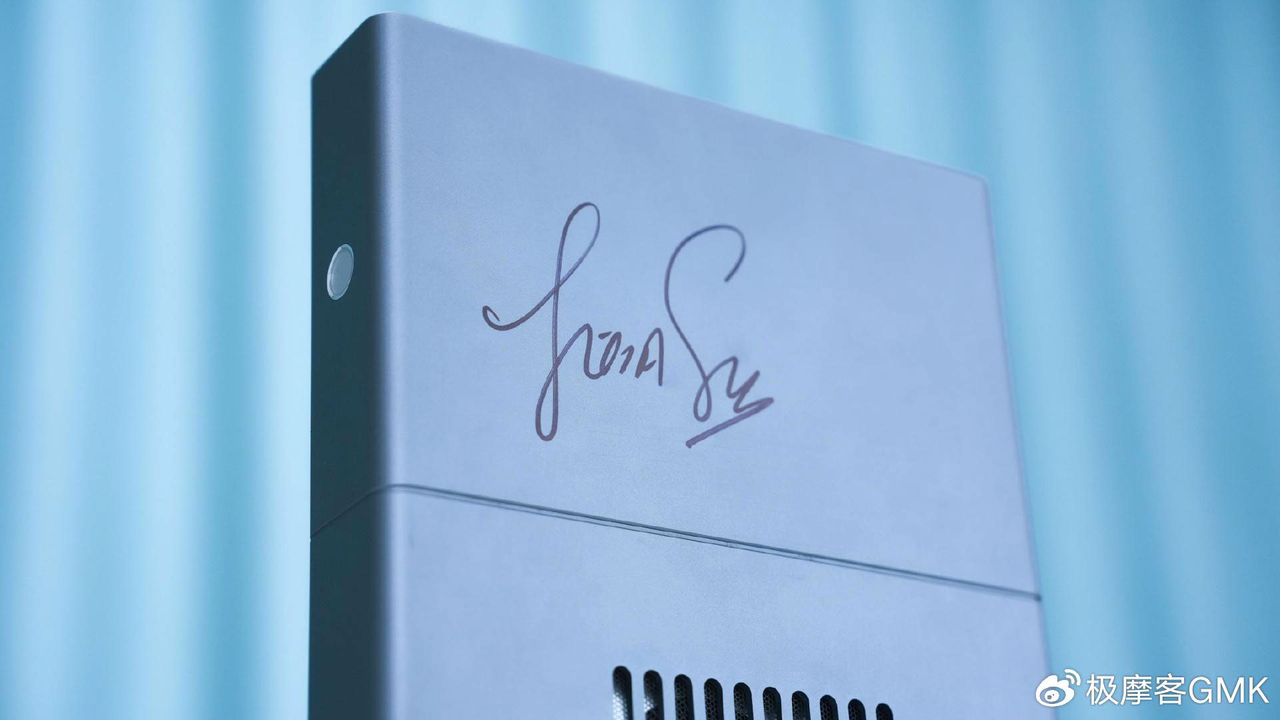
The news arrives as a snapshot, a photo showing the unseen GMKtec EVO-X3 with Lisa Su’s autograph prominently displayed, almost like a stamp of approval. There are no released spec sheets, no benchmarks, but the message is clear: the AI mini PC workstation is no longer a niche, and the redesigned EVO-X3 aims to become a reference point for local deployment of LLM workloads.
Strix Halo core: a concentration of power for inference
The machine is powered by the AMD Ryzen AI Max+ 395, part of the Strix Halo family. This generation brings a newly designed integrated GPU and a unified memory architecture capable of handling workloads with billions of parameters without the need for discrete cards. It is a paradigm shift: instead of assembling bulky servers, a compact box can host inference pipelines and even light fine-tuning, with very low energy and thermal costs. The absence of declared data prevents quantifying token-per-second speed, but the choice to display Lisa Su’s signature suggests that AMD sees this product as a showcase for its AI ecosystem.
Mini PC, maximum sovereignty
For those evaluating on-premise deployment, the EVO-X3 embodies a familiar trade-off: compactness versus vertical scalability. It is not a replacement for a GPU cluster, but for an organization that must keep data on-site, away from the cloud, such a machine can represent the first link in a sovereignty strategy. Running LLMs locally means eliminating network latency, avoiding recurring consumption costs, and locking down compliance with regulations like GDPR. Strix Halo hardware, with its ability to handle large models thanks to high memory bandwidth and driver optimization, lowers the entry barrier for IT departments that until now viewed generative AI as an exclusively cloud service.
Implications for self-hosted stacks
The presence of a device with these characteristics, born for the consumer-prosumer market but with workstation ambitions, signals a shift in the on-premise framework landscape. Software like vLLM, Ollama, or LM Studio, which already simplify LLM management on consumer hardware, would find in an EVO-X3 an ideal testing ground for refining quantization and resource optimization on shared-memory APU processors. Moreover, the ability to aggregate several units on a small scale allows exploration of distributed inference architectures without facing the TCO of full-rack enterprise solutions.
A signal for those looking at the future of local AI
The appearance of the EVO-X3 is not a simple hardware launch: it is a statement. With the signature of AMD’s CEO, the device legitimizes the idea that powerful AI inference can leave data centers and inhabit desks, labs, and remote offices. It is not about replacing the cloud, but about expanding options for those who must balance control, costs, and performance. For AI-RADAR readers attentive to on-premise dynamics, this move confirms that self-hosting hardware is emerging from its artisanal phase. And the care with which AMD curated this collaboration suggests that, in the coming months, we will see other vendors position along the same lines, accelerating an ecosystem where the choice between local and remote will no longer be a dogma, but an informed architectural decision.





💬 Comments (0)
🔒 Log in or register to comment on articles.
No comments yet. Be the first to comment!