
Google has open-sourced Harness2, a mechanism that lets an AI agent modify its own harness — the system prompt, tools, memory, skills, and subagents wrapped around the model — and carry improvements from one task to the next. It is not a new LLM and it does not introduce new weights: it is a layer above the model that makes adaptation part of the execution cycle rather than a preliminary phase.
The difference from a traditional setup is substantial. Normally, a person designs the harness once and the agent uses that fixed structure for every request. With Harness2, the agent proposes changes, runs a few candidate versions, and compares performance. No correct answers or external graders are needed: the comparison is based on observed behavior. The model stays the same. What the agent learns on one task is saved and reused, so later edits start from a smarter baseline.
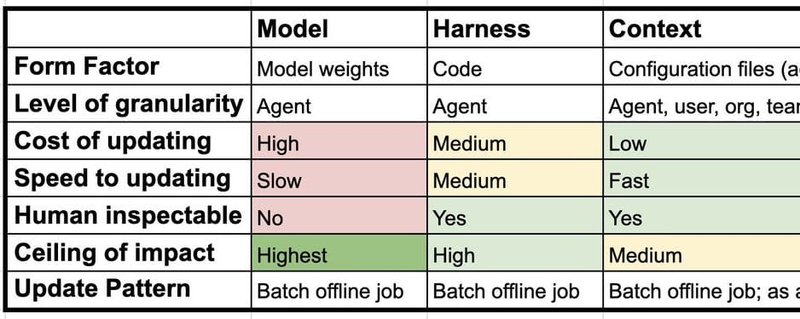
This shifts the axis of optimization. Instead of investing in fine-tuning or new checkpoints, teams can intervene on orchestration while keeping model weights frozen. For those running models in self-hosted environments, the advantage is clear: the base model remains a controlled, auditable artifact, while evolution happens in a separate layer that is easier to inspect and review. That matters in contexts where traceability and data sovereignty count more than chasing the last fraction of accuracy.
But the computational cost needs to be read carefully. Each improvement round requires running additional candidate versions — not training, but repeated inference. A self-improving harness consumes more tokens and resources than a static one. The question for anyone sizing local infrastructure becomes whether the adaptation gain justifies flexible compute capacity able to absorb evaluation spikes. The source does not report throughput metrics or VRAM requirements, but the structural signal is clear: optimization is moving from training to orchestration, and that changes the load profiles of machines dedicated to LLMs.
The tests cited by Google with Gemini 3.5 Flash and GLM-5 on legal, office, and professional work benchmarks show that even one round of edits beats the original harnesses, and more rounds push scores higher. That result is especially interesting for teams that want to deploy specialized agents on sensitive data: instead of relying on an external provider to adapt the model, they can distribute a harness that refines itself locally. The open-source release on GitHub reinforces this direction, since the whole mechanism is inspectable and can be integrated into existing pipelines.
For on-premises deployments, the trade-offs are precise: control and harness transparency must be weighed against higher resource consumption from concurrent evaluations. Harness2 does not resolve that dilemma, but it makes it explicit and, for the first time, addressable without touching the model weights.




💬 Comments (0)
🔒 Log in or register to comment on articles.
No comments yet. Be the first to comment!