
Google's Strategy and the Evolution of TPUs
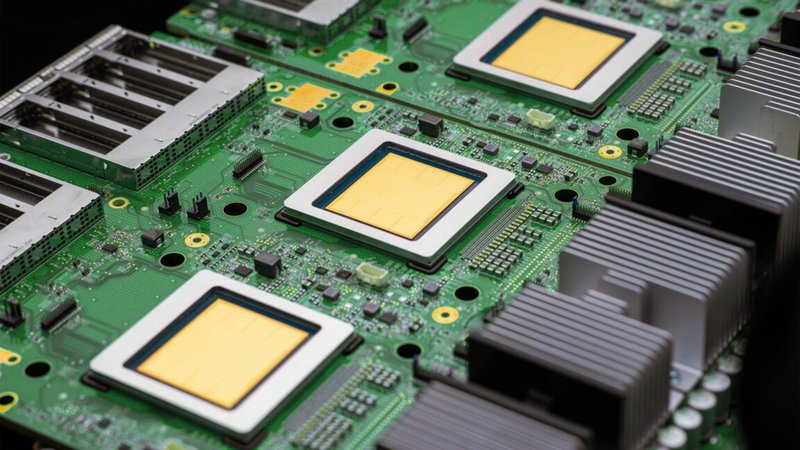
Google has heavily invested in the development of its Tensor Processing Units (TPUs), chips specifically designed to accelerate machine learning workloads. These units have been a cornerstone of Google Cloud's infrastructure, offering high performance and energy efficiency for training and inference of Large Language Models and other AI models.
The recent diversification in TPU usage, as reported by DIGITIMES, suggests an expansion of their application beyond traditional boundaries, potentially integrating these solutions into a broader ecosystem or different service tiers. This strategic move reflects Google's desire to maintain a competitive edge in the AI sector by optimizing the entire hardware and software stack.
The Competitive Landscape of AI Accelerators
The AI accelerator market is rapidly evolving, with a growing trend among tech giants to develop their own custom silicon. In addition to Google with its TPUs, companies like Amazon (with Inferentia and Trainium) and Microsoft (with Maia and Cobalt) are investing in proprietary ASICs to reduce dependence on external suppliers and to optimize the costs and performance of their cloud services.
This trend puts pressure on traditional chip manufacturers and ASIC partners, such as MediaTek, who have historically provided customized hardware solutions for a wide range of applications. Google's diversification implies that a larger share of its internal demand for AI accelerators could be met by its own TPUs, reducing opportunities for external vendors.
Implications for Partners and the Silicon Market
For companies like MediaTek and other ASIC partners, Google's strategy represents a significant challenge. They must now navigate a market where their primary customers are also becoming their competitors, at least for a portion of their needs. This could push partners to seek new markets, specialize further in specific niches, or innovate to offer solutions that surpass the capabilities of the tech giants' proprietary chips.
This dynamic highlights a structural shift in the AI silicon sector. While in the past chip suppliers could rely on a more linear business model, they now face the complexity of vertically integrated ecosystems. This scenario demands agility and the ability to adapt quickly to changing customer needs and the strategies of major industry players.
Considerations for On-Premise LLM Deployments
For enterprises evaluating on-premise deployments of Large Language Models, the trend towards custom silicon by hyperscalers has several implications. While the innovation driven by Google and others can lead to technological advancements that eventually filter into the broader market, it can also complicate the acquisition of optimized hardware for self-hosted AI workloads.
Organizations prioritizing data sovereignty, infrastructure control, and predictable TCO often opt for on-premise solutions. In this context, the availability of standard GPUs (such as those from NVIDIA or AMD) remains crucial, but the increasing fragmentation of the AI accelerator market requires careful evaluation of trade-offs between performance, cost, availability, and compatibility with existing software frameworks. AI-RADAR offers analytical frameworks on /llm-onpremise to evaluate these trade-offs, helping companies navigate the complexities of self-hosted deployments.





💬 Comments (0)
🔒 Log in or register to comment on articles.
No comments yet. Be the first to comment!