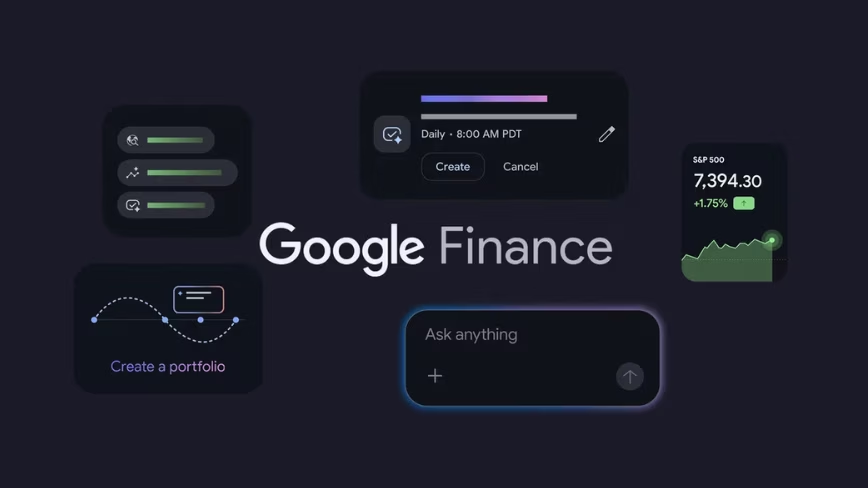
It's not just scheduled notifications and a finally standalone app. When Google pushes Gemini into Finance and takes it out of beta a year after the revamp, it's drawing a deeper line than it might seem. The Mountain View giant announced the launch of a native Android app, portfolio tracking features, scheduled market briefings, and a research tool powered by generative AI, with an iOS version promised to follow. All built on the Gemini architecture that began reshaping the service from August 2025.
For those following the world of Large Language Models, the news reads on two levels. The first is immediate functionality: an increasingly autonomous financial assistant capable of distilling market information, sending personalized summaries at set times, and helping users monitor assets in real time. The second – and the one that concerns us here – is the systemic signal: LLM-based mainstream services are colonizing spaces where data is exceptionally sensitive. Portfolios, search history, investment habits: everything flows toward Google's cloud.
The invisible architecture: Gemini as a diffuse processing layer
Behind the scenes, the new Google Finance isn't a simple restyling. Integration with Gemini turns the app into a client that draws on state-of-the-art language models to generate summaries, answer complex questions, and even produce personalized briefings. Technically, inference happens on Google's servers, and the Android device merely acts as an interface. This cloud-centric approach guarantees acceptable latencies and continuous model updates, but it raises questions about quantization, bandwidth consumption, and above all, on-device computation.
There are no specifications on potential local or hybrid models, but the industry trend is clear: shifting computational load to the cloud allows Google to maintain full control over the pipeline and to train models on aggregated data. What remains to be seen is whether, in the future, part of the processing could migrate to devices, perhaps using NPUs or small quantized models to guarantee basic offline functionality – a topic close to the heart of those designing on-premise or edge solutions.
Data sensitivity and sovereignty: the flip side of the coin
The arrival of generative AI in a personal finance app spotlights a now structural problem: every interaction generates data that describes the user with chilling precision. For companies or professionals managing others' portfolios, the issue is not just privacy but regulatory compliance. GDPR imposes strict rules on personal data processing and localization, and entirely cloud-based services can clash with data residency requirements.
Google Finance, like other platforms, declares security and encryption policies, but for a growing number of entities, the true guarantee remains direct control over the infrastructure. That's why every announcement of this kind reinforces the tension between the convenience of consumer AI services and the need to keep sensitive data within one's own perimeter. If a bank or a consultancy firm wanted to replicate a similar experience for its clients, it would hardly entrust everything to a public cloud service: this is where self-hosting frameworks and on-premise solutions designed for LLM inference come into play.
Beyond the app: what it teaches those evaluating local deployments
Google's move has a didactic value for anyone designing their own AI stack. It shows that integrating LLMs into 'everyday' applications is no longer a niche experiment but a must to stay competitive. However, it also highlights the trade-offs: a cloud service is quick to deploy and always updated, but it forfeits from the outset any guarantee of data sovereignty. Conversely, on-premise infrastructure allows full control over the entire flow, but it requires investments in specialized hardware, model management, and pipeline orchestration.
Total Cost of Ownership in these scenarios isn't measured in euros alone, but in the ability to negotiate the level of data exposure. And while Google pushes its AI-first vision, the market is responding with a growing array of solutions for local inference: from servers with dedicated GPUs to toolkits for fine-tuning in air-gapped environments. The lesson is that every architectural choice begins by defining what we are willing to delegate – and what we instead want to safeguard.







💬 Comments (0)
🔒 Log in or register to comment on articles.
No comments yet. Be the first to comment!