The Challenge of Authenticity in the AI Era
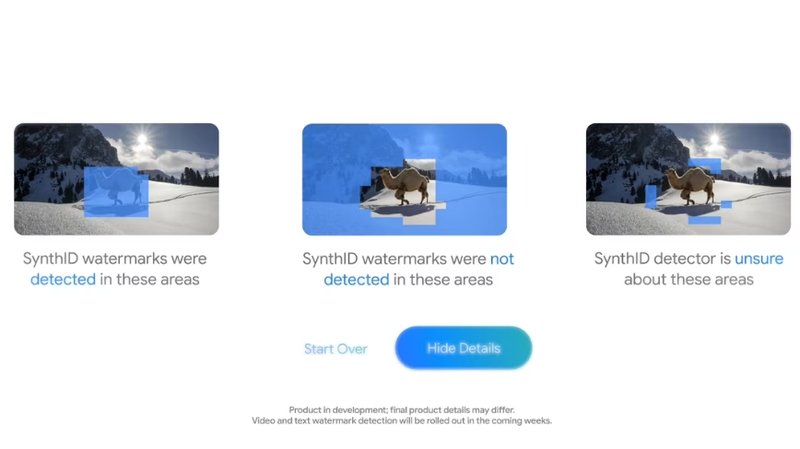
The evolution of Large Language Models (LLM) and generative models has ushered in an era where distinguishing real content from synthetic content has become increasingly complex. From images with imperfect details, we have moved to digital creations of astonishing realism, making the question of authenticity a priority. In this context, Google has proposed SynthID, an AI-powered watermarking technology, first demonstrated three years ago, which is now gaining traction well beyond Google's ecosystem.
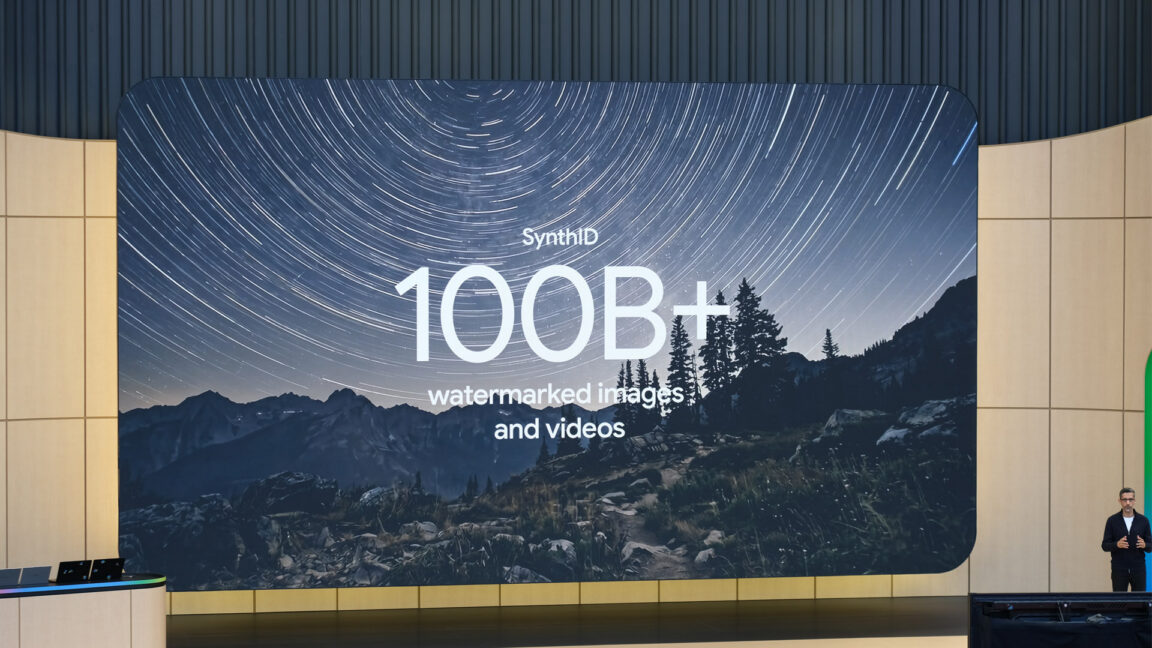
The reach of SynthID is already significant: the company has stated that the technology has been used to label over 100 billion images and videos, plus an audio volume equivalent to 60,000 years. These numbers are set to grow further, as SynthID's adoption is expanding, including prominent industry players like OpenAI and Nvidia, signaling a growing recognition of the importance of tools for verifying the provenance of AI-generated content.
SynthID and the C2PA Standard: A Complementary Approach
SynthID is not Google's only strategy for AI content labeling. The company is also strongly committed to supporting the C2PA (Coalition for Content Provenance and Authenticity) standard, a framework that allows metadata to be associated with digital content, describing its creation process and any modifications. Google began integrating C2PA more prominently with its Pixel 10 smartphones, where photos taken include detailed metadata about their processing.
This integration goes beyond simple capture information: if a highly zoomed image includes generative elements created by AI, it is automatically marked with a specific tag. Google has announced that this functionality will be extended to videos recorded on Pixel 8, 9, and 10 models via a software update in the coming weeks. Furthermore, C2PA scanning capability will be introduced into Gemini, allowing the chatbot to explain a file's provenance based on content labeling. This same functionality will also come to Chrome and Search in the coming months, further expanding the ability to verify the provenance of digital content.
Implications for Data Sovereignty and On-Premise Deployments
The increasing adoption of technologies like SynthID and C2PA underscores a critical need for organizations: the ability to ensure the provenance and integrity of data and content, especially that generated or processed via LLMs. For companies evaluating on-premise deployments or self-hosted solutions for their AI workloads, data sovereignty and regulatory compliance are absolute priorities. Tools that allow tracing the origin of AI-generated content become fundamental for audits, compliance with regulations like GDPR, and maintaining stakeholder trust.
In an environment where sensitive data is managed locally, verifying the authenticity of AI-produced content is not just a technological issue, but also a strategic one. It directly impacts data governance and an organization's ability to demonstrate full control over its technology stack and its outputs. While SynthID and C2PA are not on-premise deployment solutions themselves, their existence and adoption highlight the universal need for transparency, a crucial factor for anyone operating with LLMs, regardless of the chosen infrastructure. For those evaluating on-premise deployments, AI-RADAR offers analytical frameworks on /llm-onpremise to assess trade-offs and specific requirements related to data provenance and security management.
Future Prospects for Digital Trust
SynthID's expansion and the commitment to open standards like C2PA represent significant steps towards building a more transparent and trustworthy digital ecosystem. However, the challenge of distinguishing real content from AI-generated content is constantly evolving, with generative models becoming increasingly sophisticated. This requires continuous innovation in both watermarking techniques and metadata systems.
The future of digital trust will depend on the industry's ability to develop and adopt robust, interoperable solutions that can withstand the advancement of generative capabilities. The combined approach of invisible watermarking and explicit metadata, as promoted by Google, offers a promising path to provide users and organizations with the necessary tools to navigate an increasingly complex media landscape, ensuring that content provenance can be verified with certainty.







💬 Comments (0)
🔒 Log in or register to comment on articles.
No comments yet. Be the first to comment!