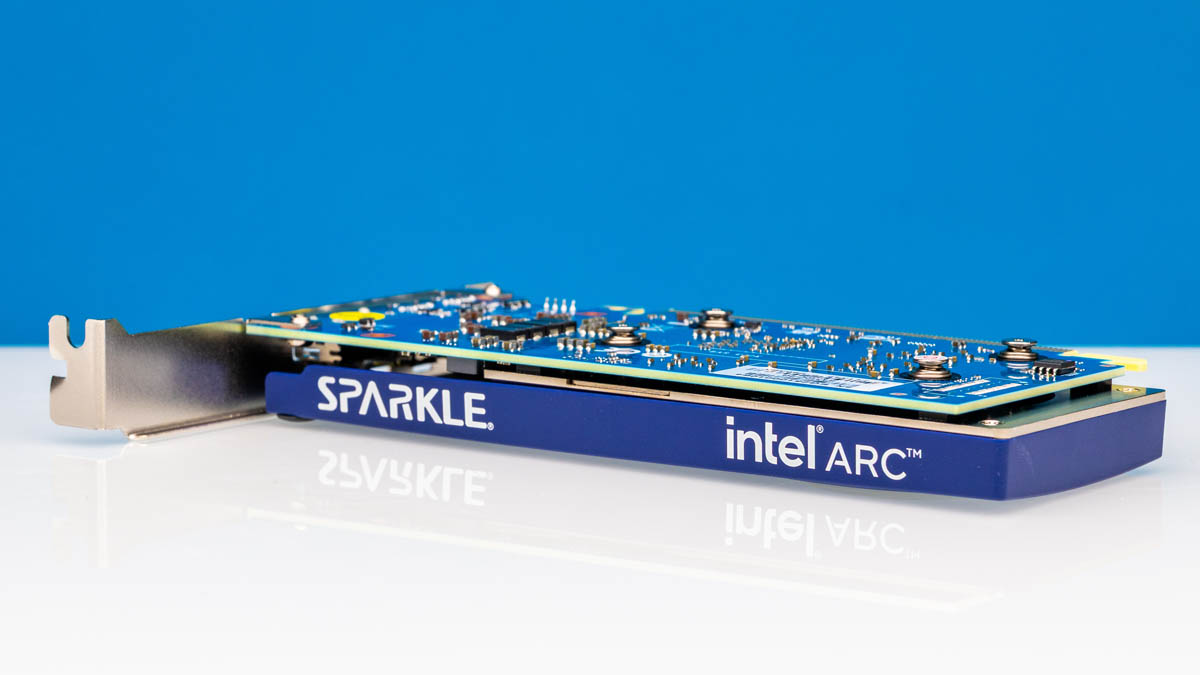
The Sparkle Intel Arc A310 ECO: A GPU for Modest Needs
In today's artificial intelligence landscape, often dominated by high-performance GPUs with tens of gigabytes of VRAM, the Sparkle Intel Arc A310 ECO takes a different approach. This graphics card, characterized by a compact design and reduced power consumption, is intended to meet more modest computing needs, offering an efficient solution for specific applications. With 4GB of VRAM and a Low Profile PCIe form factor, it positions itself as an option for those seeking a balance between functionality and footprint.
Its "ECO" nature suggests a particular focus on efficiency, an increasingly relevant factor for on-premise deployments and edge infrastructures. In contexts where space, thermal dissipation, and power consumption are stringent constraints, a GPU like the A310 ECO can represent a pragmatic choice, while acknowledging the inherent limitations of such a hardware configuration for the most intensive workloads.
Technical Details and Implications for LLMs
The Sparkle Intel Arc A310 ECO integrates 4GB of VRAM, a specification that clearly defines its scope of application, especially in the context of Large Language Models (LLMs). For the inference of large LLMs, which often require tens or hundreds of gigabytes of VRAM to load model parameters, 4GB represents a significant constraint. This means the GPU is primarily suitable for very small models, for running inference on heavily quantized models (e.g., 4-bit or 2-bit), or for less demanding natural language processing tasks.
Its Low Profile PCIe form factor facilitates integration into compact systems, such as industrial mini-PCs, edge servers, or workstations with limited space. This feature, combined with low power consumption, makes it ideal for scenarios where resources are constrained and reliability in sub-optimal environments is crucial. However, it is essential for DevOps teams and infrastructure architects to carefully evaluate the specific requirements of the LLM models they intend to deploy, to ensure the GPU's capacity aligns with expected performance.
Deployment Context: Edge AI and On-Premise Prototyping
The positioning of the Sparkle Intel Arc A310 ECO makes it particularly interesting for Edge AI deployments. In these scenarios, data processing occurs as close as possible to the source, reducing latency and bandwidth requirements, and ensuring greater data sovereignty. IoT devices, local computer vision systems, or embedded artificial intelligence applications can benefit from a compact, low-power GPU to perform inference locally, without needing to rely on cloud resources.
For companies exploring self-hosted solutions, this GPU can also serve as a component for prototyping or light development workloads on bare metal infrastructures. While not suitable for training complex models or for high-end LLM inference, it offers an accessible entry point for experimenting with hardware acceleration in a controlled environment, keeping operational costs and overall TCO low.
Prospects for Local AI Infrastructure
The emergence of GPUs like the Sparkle Intel Arc A310 ECO highlights an important trend in the AI industry: not all applications require the computational power of a hyperscale data center. There is a growing demand for efficient and scalable solutions for local deployment, where data sovereignty, compliance, and cost management are decisive factors. This GPU fits into this niche, offering hardware acceleration capabilities for specific tasks.
For CTOs and infrastructure architects, evaluating hardware like the A310 ECO requires a thorough analysis of the trade-offs between cost, power consumption, size, and computational capacity. While it may not be the choice for the most demanding LLM workloads, its existence underscores the diversification of hardware options available for building resilient and optimized AI infrastructures for on-premise needs.







💬 Comments (0)
🔒 Log in or register to comment on articles.
No comments yet. Be the first to comment!