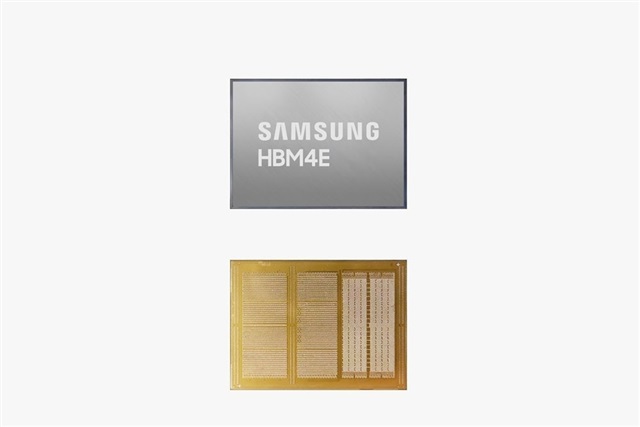
Samsung has crossed a threshold that matters more than a single percentage point. Its HBM4E memory yield has exceeded 70%, turning a technical milestone into a concrete market signal. In an ecosystem where every extra bit of bandwidth determines how well increasingly large models can be served, the news intensifies the three-way race with SK Hynix and Micron and reshapes availability timelines for those designing AI infrastructure.
High Bandwidth Memory has long been the costliest bottleneck for Large Language Model workloads. Unlike traditional DRAM, HBM stacks sit next to compute silicon, multiplying bandwidth and shortening electrical paths—advantages that translate into higher tokens per second and context windows that can be managed without latency degradation. With the extended fourth generation (HBM4E), manufacturers are targeting even greater density and clock speeds, yet the true discriminator remains the ability to produce at viable volumes. A yield above 70% means fewer than one-third of dies are discarded, a condition that brings the economic break-even closer and makes broader supply plausible.
For organizations that keep AI workloads in house, this number is far from abstract. The choice of an accelerator is tightly coupled with available VRAM, and HBM memory has a direct impact on total cost of ownership: each additional gigabyte of bandwidth reduces the need to split computation across nodes, lowering energy consumption and orchestration complexity. A market with three competitive suppliers—rather than the de facto duopoly that characterized previous generations—could soften pricing and speed the adoption of self-hosted solutions even for models that today seem confined to the cloud.
It is still unclear when the first HBM4E-based products will reach server trays, but yield progression is a reliable leading indicator. Samsung, which has poured investment into advanced packaging, is eager to close the gap it suffered in the early stages of the AI race, while SK Hynix remains the dominant supplier for major GPU vendors. Micron, for its part, has bet on an aggressive roadmap that skips intermediate generations to aim directly at HBM4E variants.
In this tangle of industrial strategies, production yield is not merely a factory-floor statistic. It is the multiplier that decides whether a technology stays confined to labs or scales into the backbone of reliable on-premise architectures. The three-way contest, now more sharply drawn, promises to write the next chapter of computational sovereignty.






💬 Comments (0)
🔒 Log in or register to comment on articles.
No comments yet. Be the first to comment!