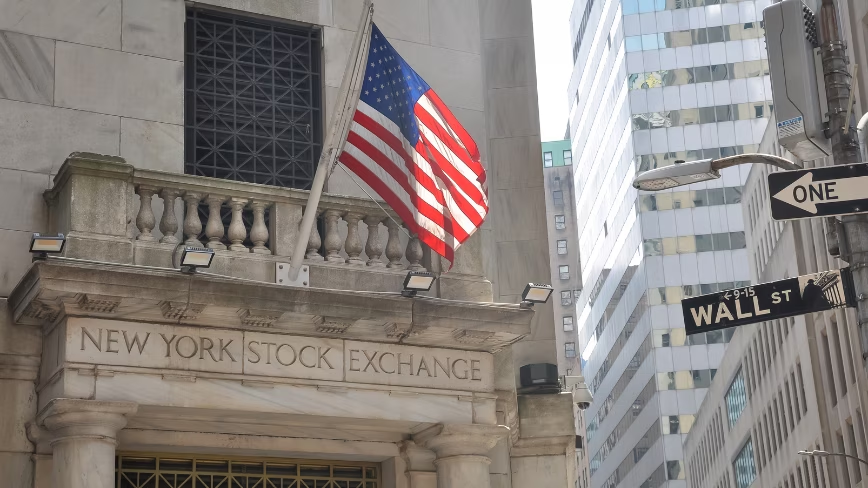
Data from Goldman Sachs’ prime brokerage shows that for the fourth consecutive week, hedge funds have reduced their stakes in semiconductor stocks. Chipmakers and their equipment suppliers have become the most heavily net-sold corner of the entire U.S. market. The move comes as parts of the so-called “AI trade” wobble.
For those tracking the LLM and on-premise deployment space, this isn’t just background noise from the trading floor. Semiconductors are the physical foundation of every training and inference pipeline. GPUs, accelerators, high-bandwidth memory: each component directly impacts the TCO of a self-hosted infrastructure. When the financial market dumps sector stocks, it raises questions about future demand and profitability.
What’s driving the selling? The hedge fund outflows coincide with a wobble in certain parts of the AI trade. Whether it’s simple profit-taking after years of rallies or a deeper reassessment isn’t clear: perhaps the market is pricing in a slowdown in AI infrastructure investment, or slower-than-expected adoption. Efficiency gains also play a role: smaller models, aggressive quantization, and less resource-intensive fine-tuning techniques could reduce the hunger for silicon without sacrificing computational capacity.
For organizations evaluating on-premise deployments, these financial dynamics offer concrete insights. A cooling of speculative demand could, in the medium term, translate into downward pressure on hardware prices, improving the business case for those yet to purchase. At the same time, a pullback in investment could slow product innovation, lengthen upgrade cycles, and make access to cutting-edge technology more difficult.
It’s a delicate balance. The hedge fund exodus isn’t a prediction but a signal of caution. Real demand for AI compute, coming from enterprises, research centers, and public administrations, isn’t measured solely by daily stock market flows. Supply data, delivery lead times, and distribution channel trends remain more reliable indicators for hardware planning. At AI-RADAR, we continue to track the interplay between financial markets and the on-premise stack, because every swing can become an edge for those who read the right signals.







💬 Comments (0)
🔒 Log in or register to comment on articles.
No comments yet. Be the first to comment!