
Hotai Motor has trimmed its near-term outlook for Taiwan's auto market while keeping its 2026 sales target unchanged. Read between the lines, and the move reveals more than a simple forecast tweak: it captures an industry learning to navigate macroeconomic headwinds and supply-chain volatility without letting go of its medium-term course.
That same balance between immediate caution and underlying ambition reappears almost identically when manufacturing companies – automotive included – decide how to bring artificial intelligence into their processes. The question is no longer “if” but “where” to run the models: in the cloud, paying as you go, or on their own infrastructure, accepting a higher upfront cost in exchange for total control.
A carmaker like Hotai, operating in a heavily regulated and fiercely competitive regional context, brings three familiar tensions to the surface for anyone dealing with on-premise deployment. First, data sovereignty. In fields where autonomous driving projects or predictive maintenance generate continuous streams of telemetry and imagery, pushing everything onto third-party servers means accepting compliance risk and jurisdictional dependency. Keeping workloads in-house – or in a nearby data center – returns full ownership of the data and simplifies audits.
The second factor is cost predictability. Pure cloud follows a variable OpEx model, convenient at the start but vulnerable to spikes when large-scale inference or periodic fine-tuning multiplies the tokens processed. The total cost of ownership, or TCO, of self-hosted infrastructure can be calibrated more reliably against predictable volumes, and that’s precisely why some manufacturers choose to invest in GPU clusters even for workloads that might appear “cloud native.”
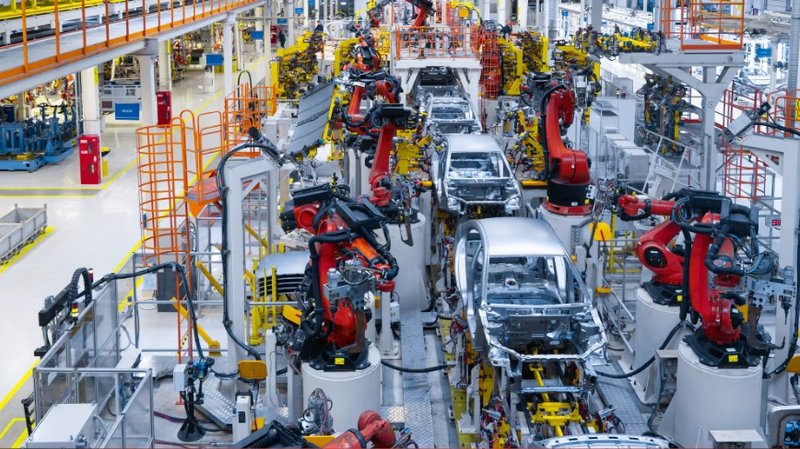
Finally, latency and operational reliability. A vision model inspecting components on the line must respond in milliseconds, without relying on internet connectivity or the whims of an external API. Edge computing here is not a buzzword but a physical requirement: local racks with dedicated GPUs – perhaps 80 GB VRAM units for segmentation models – become as much a part of the production floor as a welding robot.
Looking toward 2026, the year for which Hotai reaffirms its sales ambitions, on-premise technology will likely have closed part of the maturity gap with cloud services. Serving frameworks like vLLM or TGI already allow orchestrating multiple models across different nodes, while quantization techniques push ever-larger models into tight memory budgets. The trade-off between management complexity and autonomy remains, but in sectors where every hour of line stoppage costs tens of thousands of euros, the scales often tip toward autonomy.
For those now charting their company’s AI roadmap, Hotai’s gesture – short-term caution, long-run determination – suggests a pragmatic approach: start with hybrid setups, testing workloads in the cloud and progressively moving on-premise the processes that touch proprietary data or demand strict SLAs. It is not a frictionless path, but it helps keep the helm steady even when market weather advises trimming the sails.







💬 Comments (0)
🔒 Log in or register to comment on articles.
No comments yet. Be the first to comment!