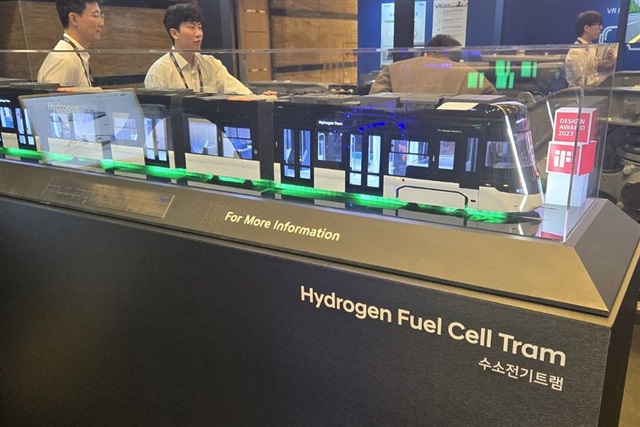
In southern China, the Foshan hydrogen tram project – one of the world's first – is grappling with higher-than-expected operating costs. The news, reported by DIGITIMES, comes as Hyundai Rotem announces plans to put its own hydrogen train on the tracks by 2029. Two developments that, at first glance, seem far removed from the world of artificial intelligence. But that’s not the case.
Green hydrogen, produced through electrolysis powered by renewable energy, is often touted as a solution for decarbonizing sectors that are hard to electrify directly. Heavy transport, energy-intensive industries, and, in recent years, data centers. The idea of running IT infrastructure on fuel cells is not new: Microsoft tested a hydrogen-powered data center for 48 consecutive hours as early as 2022, and other operators are looking at hydrogen as an alternative to diesel generators for backup and, in the longer term, for continuous operation in areas with unstable grids or high electricity prices.
The Foshan experience – details of which, unfortunately, were not disclosed in the source – casts a shadow on the technology’s economic competitiveness. Without inventing figures, it is well known that the cost of green hydrogen remains two to three times higher than diesel or natural gas per equivalent energy unit, according to the latest estimates from the International Energy Agency. The same arithmetic applies to any stationary application, data centers included.
For those weighing on-premise deployment of heavy AI workloads – LLMs, continuous inference, fine-tuning on proprietary data – energy cost is as decisive a factor as the hardware itself. High-end GPUs, from H100s to A100s, consume hundreds of watts each; a training cluster can easily push the annual energy bill into the hundreds of thousands of euros. If hydrogen were to become a primary fuel source rather than a niche option, the economics of on-premise AI could shift dramatically. This is especially true for entities operating in air-gapped environments or under data sovereignty requirements that mandate isolation from the public electrical grid, perhaps in remote sites or in countries with strict regulatory regimes.
Granted, the parallel has limits: a hydrogen train moves, requires distributed refueling infrastructure, and must contend with weight and space constraints that a data center does not. But the challenges of production, storage, and distribution of hydrogen cut across sectors. The Foshan story, with its higher-than-expected operational costs, signals that large-scale commercial viability is still a work in progress – a timely reminder for anyone envisioning fully hydrogen-powered data centers by the end of this decade.
Ultimately, the Hyundai Rotem-Foshan case is more than a rail industry story. For the AI ecosystem that is pushing toward self-hosted infrastructure and energy independence, it is a signal not to be ignored: the hydrogen transition demands realism about timelines and costs. AI-RADAR will keep tracking the evolution of energy infrastructures as they intersect with the deployment choices of those building and training models firsthand.









💬 Comments (0)
🔒 Log in or register to comment on articles.
No comments yet. Be the first to comment!