
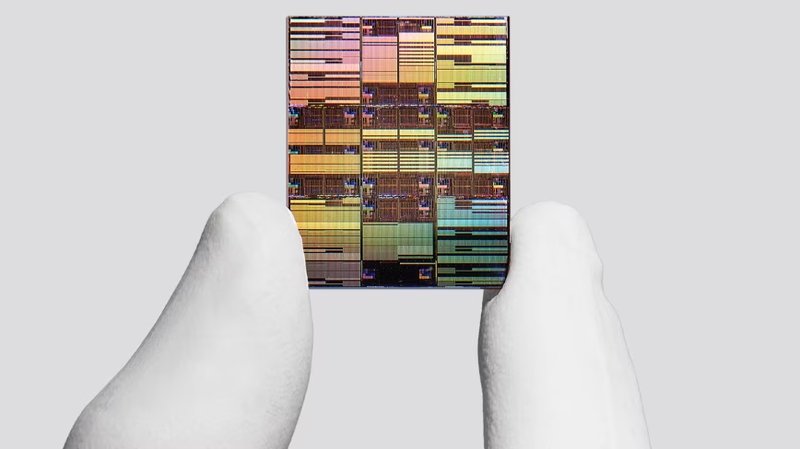
When IBM claims a sub-1 nanometer chip technology, the immediate thought is about a lithography breakthrough. But the nanostack architecture is not about finer printing: it’s a paradigm shift that multiplies transistor density without trespassing physical barriers. The result? Performance equivalent to a hypothetical chip with gates smaller than 1 nanometer—nearly 100 billion transistors on an area the size of a human fingernail.
Jay Gambetta, director of IBM Research, calls it «a meaningful leap forward» toward significantly more powerful computing without a corresponding increase in energy consumption. This is precisely where the innovation intersects the concerns of those managing on-premise infrastructure: the promise of more muscle without having to multiply cooling and power costs.
Nanostack: not lithography, but efficiency
The “sub-1 nanometer” label is deliberately provocative. Building physical transistors smaller than 1 nm is unfeasible because quantum effects would render operation unreliable. IBM sidesteps the problem with a three-dimensional architecture—nanostack—that stacks and connects components in a way that increases density without further shrinking planar geometries. This yields up to twice the transistor count of the previous generation in the same footprint.
The invention has an immediate impact on AI workloads, where density translates to parallel computing capacity and greater efficiency in running inference for large neural networks. For those deploying LLM models internally, it means handling extended models with lower latency and without resorting to expensive multi-GPU clusters. It’s not just raw power, but a performance-per-watt ratio that could redraw the convenience threshold for self-hosted setups.
AI data centers: closing the gap between performance and consumption
AI-focused data centers are energy-hungry, and every capacity increase threatens to worsen the balance. IBM’s bet is to reverse the trend: maintain (or boost) performance while reducing energy footprint per transistor.
For organizations evaluating on-premise deployment, this touches two sensitive spots: TCO and data sovereignty. A chip that offers more throughput within the same thermal budget makes it realistic to keep inference and even light fine-tuning tasks in-house, cutting cloud connectivity costs and latency constraints. In regulated sectors like finance and healthcare, where data residency is paramount, the advantage is not just economic but also about compliance.
There are no official benchmarks attached to the announcement, yet the direction is clear: innovation is no longer running only on outright miniaturization but on stacking and architectural optimization. If manufacturing partners manage to bring nanostack to scale, we will witness a step change for in-house AI hardware.
Beyond the hype: what’s missing for production
Open questions remain. Moving from a lab-demonstrated technology to commercial production takes years and investments in packaging and testing ecosystems. Moreover, for heavy workloads such as training LLMs with tens of billions of parameters, aspects like memory capacity and bandwidth will also weigh in—variables on which IBM did not provide details.
Still, the announcement marks a turning point in how semiconductor progress is conceived. Instead of exhausting itself in the physical nanometer race, the industry begins to explore the third dimension with solutions that speak the language of modern data centers: higher density, less wasted energy. For those designing on-premise deployments, nanostack could become the backbone of a generation of AI servers where power is no longer negotiable at the expense of operational efficiency.





💬 Comments (0)
🔒 Log in or register to comment on articles.
No comments yet. Be the first to comment!