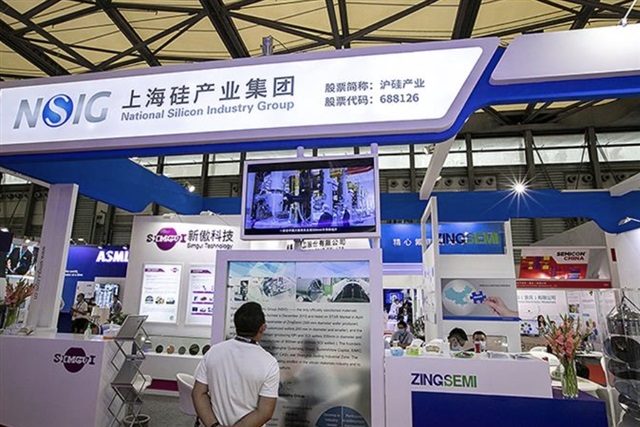
Yicai reports that China’s wafer champion is preparing a $1.6 billion overhaul to reverse a cycle of losses. This is not just the financial diary of a single company; it is a symptom of cutthroat competitive pressure in the semiconductor sector, where the race toward advanced process nodes and installed capacity devours capital relentlessly.
An overhaul that spells survival
From the few details available, the operation aims to retool production lines, likely to transition to more efficient process technologies or to boost yields in a market where margins and volumes chase each other fiercely. The company was not named directly in the headline, but China’s wafer landscape is dominated by players like YMTC for 3D NAND memory or by foundries focused on logic and analog silicon. The investment is comparable to the cost of a new small-scale fab: $1.6 billion does not solve everything, but it can make the difference between financial collapse and catching the next technological wave.
Why the wafer race matters for on-premise builders
Those who build local infrastructure for LLMs know that every GPU, every accelerator, starts on a silicon wafer. Investment decisions by wafer manufacturers ripple through the availability and cost of chips for inference and training. If a major Asian player struggles to halt losses, the market could shudder: on one hand, potential overcapacity from restructuring could trigger short-term price drops; on the other, forced consolidation narrows supply sources, raising risks for anyone planning medium-term on-premise deployments. Data sovereignty requires in-house servers and accelerators, but the raw material remains global.
The bigger picture: fragmentation and TCO
This event fits into a trend of supply chain fragmentation, with the US, Europe, and Asia all trying to build local production pipelines. For an organization evaluating the TCO of a bare metal cluster for fine-tuning models, uncertainty about silicon supplies is a real variable. Trade wars and US restrictions on advanced technology exports have already put Chinese companies under pressure, forcing them to invest heavily just to stay in the game. This $1.6 billion renovation can be read as a defensive move: upgrade before lines become obsolete and losses become structural.
Looking ahead
We do not know whether the overhaul will involve memories, automotive logic, or neural network chips. But it is clear that the game is being played on the ability to produce silicon at sustainable costs, with high yields and competitive nodes. For those currently ordering servers with A100 or H100 GPUs for a stable on-premise setup over the next three years, such news is more than background noise: it signals where bottlenecks might emerge or, conversely, where competitive pressure could make key components more accessible. AI-RADAR will continue to track these intersections between industrial finance and deployment architectures, because every budget decision starts with the physical availability of silicon.









💬 Comments (0)
🔒 Log in or register to comment on articles.
No comments yet. Be the first to comment!