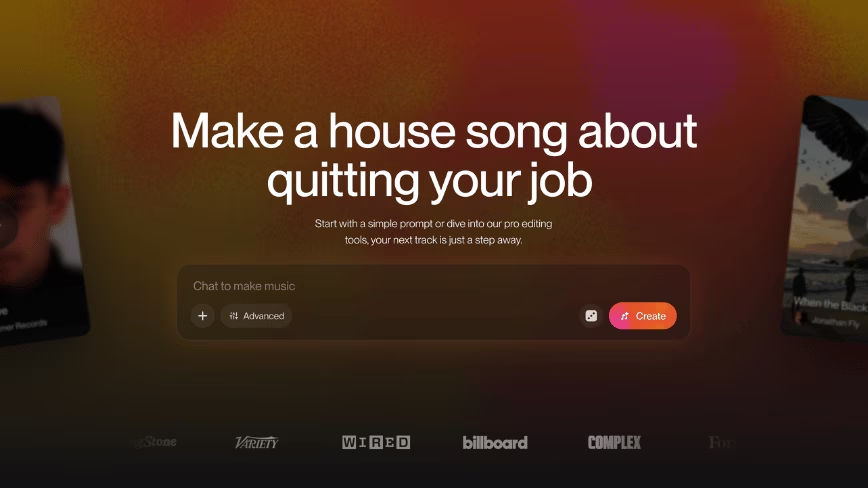
For years, musicians have claimed that AI song generators were feeding on their work without permission. Now a hacker has pried open the black box. Leaked source code from Suno, one of the most popular synthetic music platforms, tells a straightforward story: the model was trained by scraping millions of songs and lyrics from the web, with no filters or licenses.
The leak is not just an embarrassment for the company. It exposes a practice that the Large Language Models and audio generation industry has long normalized: the massive harvesting of publicly accessible data, turned into training fuel without a clear accountability framework. In text-based LLMs, the debate has centered on books and articles; in music, the skeleton of Suno's dataset shows the phenomenon is identical and perhaps even more opaque, because audio file metadata often lacks explicit provenance traces.
The illusion of synthetic creativity
Suno users type a description and get a song. The interface suggests generative magic, but the code reveals the statistical backbone: the model does not compose; it assembles sonic and textual patterns learned from other people's recordings. This goes beyond copyright and strikes at the heart of any organization evaluating AI tools in regulated environments. If a company wanted to train or even just use musical models for internal sound design, it would need to trust the cleanliness of the dataset. The leak proves that the data supply chain for audio is no less vulnerable than the textual one.
The Suno case carries structural implications for anyone pushing toward on-premise or self-hosted deployment. Data sovereignty does not end at the physical location of servers; it extends to the genealogy of the information used to build a model. An organization aiming to avoid legal and reputational risks from datasets contaminated by protected material may find itself forced to rethink fine-tuning and inference pipelines, favoring controlled environments where every source is traceable. This is not abstract: in Europe, GDPR and the AI Act impose transparency obligations that sit poorly with models fed through indiscriminate scraping.
Who loses and who gains
In the short term, the losers are music rights holders, who see confirmed their suspicion of unauthorized use of their works. But the fracture widens across the entire enterprise ecosystem: model providers that fail to document data provenance lose credibility, while AI technology buyers face potential litigation. Paradoxically, the winners are open-source platforms and projects that adopt certified or synthetic datasets, because they offer an escape route for those who cannot afford ambiguity. IT decision-makers face a fork: keep relying on opaque cloud services, or shift the center of gravity toward local infrastructure where control over the data supply chain is non-negotiable.


💬 Comments (0)
🔒 Log in or register to comment on articles.
No comments yet. Be the first to comment!