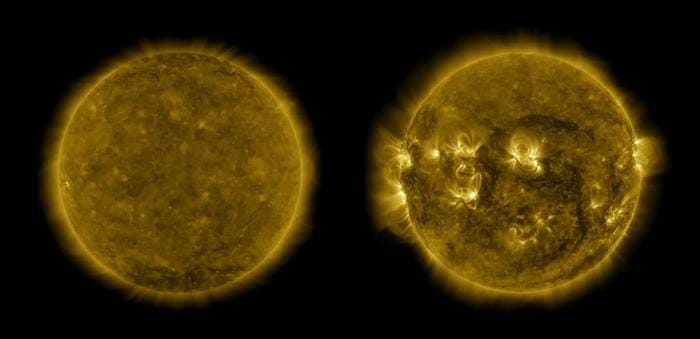
Scientists have peered inside the Sun and observed subtle shifts and "glitches" that have occurred over four decades, shedding light on the enigmatic long-term vibrations of our star, reports a study published in Monthly Notices of the Royal Astronomical Society.
The Sun goes through a roughly 11-year cycle that includes a period of high and low activity, known as solar maximum and minimum. The past few cycles have revealed changes in solar behavior that could have implications for predicting space weather and unraveling the internal dynamics of our Sun, along with other Sun-like stars.
Observations and Findings
To drill down on this mystery, researchers with the Birmingham Solar-Oscillations Network (BiSON), a network of telescopes that have monitored the Sun since the 1970s, compared the last four solar minima using this unique 40-year dataset and focused on internal vibrations that make the sun subtly oscillate.
"The entire Sun oscillates in a globally coherent way, and the oscillations are formed by sound waves trapped inside the Sun that make it resonate just like a musical instrument," said Bill Chaplin, a professor of astrophysics at the University of Birmingham who co-authored the study.
The team specifically looked for an acoustic wave "glitch" caused by an interior layer in which helium atoms lose electrons, producing a detectable change in the Sun's internal structure. This glitch was significantly stronger during the 2008–2009 minimum, suggesting that the Sun's outer interior was slightly hotter and allowed sound waves to travel faster at that time of magnetic weakness.
Future Implications
The results confirm that the Sun doesn't return to the same minimum baseline at the end of every cycle, and its activity varies within timescales of decades and centuries. Scientists hope to keep recording the long-term behavior of the Sun with projects like BiSON so that we can better understand its mercurial nature over time. This is interesting work on its own merits, but it is also useful for refining forecasts of space storms that can wreak havoc on power grids and space assets.
Chaplin also nodded to the European space telescope PLAnetary Transits and Oscillations of stars (PLATO), due for launch in 2027. This mission will search for analogous oscillations in stars beyond the Sun, building on similar work conducted by NASA's retired Kepler space telescope.
Studying the vibrations of the Sun and other similar stars is not only important for life here on Earth; it also has implications in the search for extraterrestrial life, because local solar activity is one key to assessing the habitability of star systems similar to our own.






💬 Comments (0)
🔒 Log in or register to comment on articles.
No comments yet. Be the first to comment!