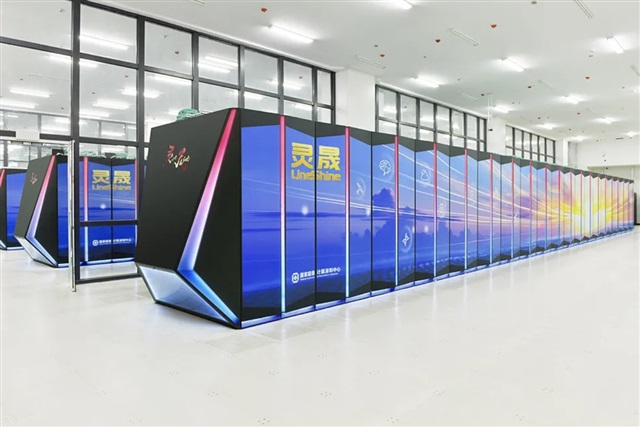
When a supercomputer climbs to the top of the TOP500, the tech world holds its breath. That is what happened with LineShine, the made-in-China system that unseated international rivals. The National Supercomputing Centre in Shenzhen announced the result with pride, but between the lines of the news lies a crucial question: what does this ranking mean for those who develop and run artificial intelligence models on their own infrastructure?
The TOP500: Raw Power, Not AI Brains
The TOP500 measures FLOPS — floating-point operations per second — a historical metric in scientific computing. LineShine dominates that ranking, but for workloads tied to Large Language Models the metric falls short. Inference and fine-tuning on self-hosted architectures depend on VRAM capacity, throughput measured in tokens per second, quantization efficiency, and the ability to handle extended context windows without degradation. A FLOPS crown does not automatically guarantee superior performance in these areas: many supercomputers excel at traditional simulations but have yet to prove their adaptability to the training and serving pipelines of modern models.
On-Prem Supercomputing: The Real Advantage Is Control
LineShine is inherently an on-prem system: installed and managed locally, far from public-cloud dynamics. The strategic value for AI builders lies not just in raw power, but in data sovereignty. Sectors like finance, healthcare, and defense require sensitive datasets never to leave the corporate perimeter. In this scenario, an infrastructure like LineShine represents the pinnacle of a deployment that maximizes control and regulatory compliance, including GDPR constraints. However, the Total Cost of Ownership of such large-scale solutions remains prohibitive for most organizations, which is why AI-RADAR provides analytical frameworks to weigh cost, performance, and autonomy trade-offs in on-premise decisions.
AI: A Steeplechase of Software and Data
Hardware leadership does not automatically translate into AI supremacy. Advanced models demand mature distributed-training frameworks, robust data pipelines, and vertical expertise to optimize quantization without quality loss. China may field the fastest supercomputer, but the uncertainty about its real AI edge mirrors the complexity of the software stack: from orchestration libraries to production serving, every link in the chain determines the ability to turn watts into insight.
Beyond the Ranking: What On-Prem AI Really Needs
LineShine is a symbol of ambition, but for the self-hosted AI ecosystem it is a reminder not to fixate on headline numbers. The choice of accelerators with ample VRAM, thermal management, energy efficiency, and compatibility with frameworks like vLLM or TensorRT are factors that determine the success of an on-premise deployment just as much as peak power. At a time when digital sovereignty and inference latency become non-negotiable requirements, the message is clear: the AI race is won with architecture designed for the problem, not just with the FLOPS stopwatch.





💬 Comments (0)
🔒 Log in or register to comment on articles.
No comments yet. Be the first to comment!