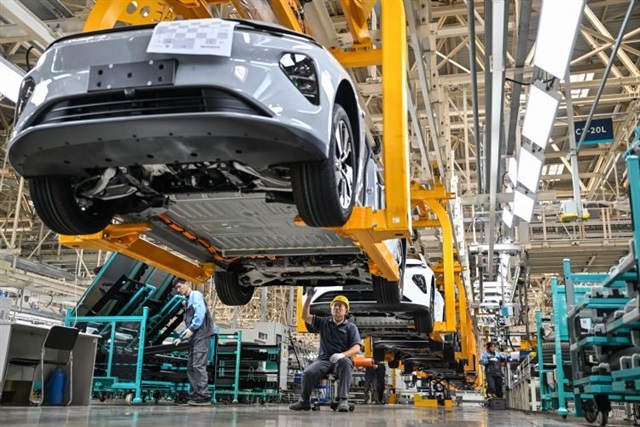
When a semiconductor cooling specialist announces that its revenue is climbing thanks to artificial intelligence, it’s not a footnote. It’s a signal that the AI industry is shifting its bottlenecks from software to the most elemental hardware: the kind that keeps chips from melting.
Iron Force, a thermal solutions manufacturer, reported a revenue increase in June, underpinned by steady automotive supply and, notably, a surge in demand for AI systems cooling. While the stability of the auto sector offers a predictable baseline, the second engine is the one charting the course ahead.
The reason is well known to anyone running high-density servers for Large Language Model inference or training. Modern GPUs – from NVIDIA A100 to H100 – dissipate hundreds of watts each, and a single rack can easily exceed 40 kW of thermal load. Traditional air cooling no longer suffices: to sustain boost clocks and avoid performance degradation over time, liquid cooling, immersion, or hybrid precision-cooling solutions are now required.
This demand is rewriting data center rules, especially for those evaluating self-hosted architectures. In an on-premise scenario, sizing the cooling system is no longer a budget afterthought but a cornerstone of Total Cost of Ownership. A miscalculation can wipe out the savings of a local deployment, leading to runaway energy costs and downtime risk.
The thermal watershed
Yet there is a subtler, second-order reading. Cooling is becoming a lock-in and differentiation mechanism. Players that master dielectric fluid immersion can build denser, quieter clusters, reducing footprint and real estate expenses. For cloud hyperscalers, this represents a competitive advantage protected by patents and proprietary know-how. For enterprises that choose the on-premise path, access to advanced cooling solutions becomes a prerequisite to avoid falling behind in the race for local compute capacity.
Seen through this lens, the Iron Force story is a leading indicator. The company doesn’t compete on silicon but on the ability to extract heat efficiently. Its growth reveals that the AI supply chain is expanding upstream, drawing in specialized players that until recently operated in niches like high-end automotive or radar systems. The convergence of thermal demands from electric vehicles and data centers suggests that the know-how is transferable, and that the market will reward those who can scale it.
For IT decision-makers, the message is clear: when planning an on-premise LLM cluster, cooling infrastructure must be part of the equation from day one, alongside GPU selection and network topology. Ignoring it mortgages the project’s viability. The question “how many tokens per second can I get?” must now coexist with “how many kilowatts can I dissipate per rack?”. In an environment of volatile energy prices and data-sovereignty pressures, a poorly dimensioned cooling plant isn’t just a technical mistake – it’s a tangible competitive risk.
The Iron Force episode thus becomes another piece of a structural transformation: artificial intelligence is no longer just a matter of code and parameters, but of applied physics, supply chains, and architectural choices rooted in thermodynamics. For those building or managing on-premise infrastructure, temperature has never been so strategic.





💬 Comments (0)
🔒 Log in or register to comment on articles.
No comments yet. Be the first to comment!