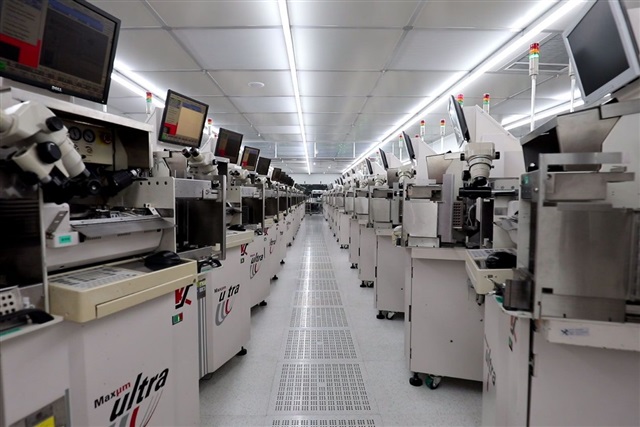
The spotlight isn't on the usual GPU designers or advanced silicon foundries this time. It's JCET, the Chinese semiconductor packaging and test services giant, that has raised its profit forecasts for the first half of the year, citing insatiable demand for AI chips.
The news shifts attention to a link in the chain that AI market narratives tend to overlook: advanced packaging. This is where silicon dies – GPUs, accelerators, high-bandwidth memory – are assembled and interconnected. Without this step, the promise of servers capable of inference on LLMs with acceptable latency or training models on on-premise clusters hits a physical wall: memory bandwidth, interconnect density, thermal dissipation.
For anyone evaluating an on-premise AI deployment today – driven by data sovereignty needs or a careful TCO analysis – JCET's news is more consequential than it appears. Packaging is not a painless commodity. Production capacity in this segment, especially for advanced technologies like multi-layer organic substrates or hybrid chip-on-wafer solutions, is limited and concentrated in a few hands: besides JCET, there are ASE Technology in Taiwan and Amkor in the United States. When these companies raise forecasts, they aren't just celebrating a good quarter; they're confirming that pressure on the supply chain extends far beyond 4 or 3 nanometer lithography.
This has at least two structural implications for the AI hardware ecosystem. The first concerns lead times and costs. If packaging becomes the new bottleneck, OEMs assembling servers for AI workloads – whether destined for cloud data centers or on-premise racks – may face longer delivery times and revised pricing. This isn't an abstract dynamic: the semiconductor supply chain already showed during the 2020-2022 chip crisis how a single tight link can propagate all the way to end customers. For an organization planning an investment in local inference capacity, this means that TCO calculations must now include explicit assumptions about price stability and future availability of accelerator cards.
The second implication is subtler but no less powerful. The growing role of advanced packaging shifts part of the competitive value from chip design to physical integration. Companies like NVIDIA or AMD depend on partners such as TSMC and, downstream, on companies like JCET to package their products. This means that the AI race, however dominated by software and model narratives, has an industrial underbelly of supply contracts, competition for capacity, and even geopolitical tensions – JCET is a Chinese firm, and packaging capacity is not immune to export restrictions or national security rationales.
For those developing or managing AI infrastructure, the signal is clear: the efficiency of an on-premise deployment is no longer measured just in tokens per second or available VRAM. One must broaden the view to the resilience of the supply chain that sits upstream of the hardware. It's no coincidence that on the AI-RADAR site, the section dedicated to on-premise deployments analyzes precisely the trade-offs related to component availability and infrastructure upgrade costs.
Ultimately, JCET's raised forecast isn't just a financial data point for industry analysts. It's a wake-up call for anyone planning to run AI models away from public clouds: the real bottleneck may be closer to the assembly line than the software industry tends to tell.






💬 Comments (0)
🔒 Log in or register to comment on articles.
No comments yet. Be the first to comment!