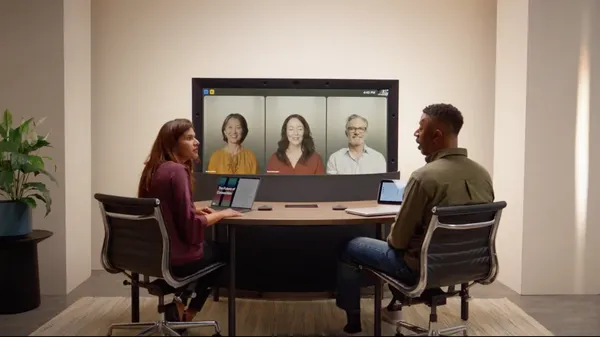
The Evolution of Hybrid Meetings with Google Beam
The landscape of hybrid work continues to evolve, bringing with it the constant challenge of maintaining a sense of connection and equality between physically present participants and those joining remotely. In this context, Google has announced a new experiment with its Beam platform, specifically designed to address these complexities. The objective is clear: to transform hybrid group meetings into more engaging and, crucially, more inclusive experiences.
Google Beam's initiative is part of a broader trend where technology companies are investing in solutions to overcome the limitations of traditional video conferencing. The pursuit of a more authentic "presence" for remote participants has become a priority, driving innovations that reduce perceived distance and improve non-verbal communication, which is often lost in current digital environments.
A True-to-Life Visual and Auditory Experience
At the core of the Google Beam experiment is the ability to offer a "true-to-life" visual and auditory experience. This means that remote colleagues should appear and sound as if they were present in the same room, with dimensions and audio clarity that replicate face-to-face interaction. This approach aims to reduce the cognitive fatigue often associated with virtual meetings, where interpreting subtle cues can be challenging.
Implementing a more realistic representation can significantly impact meeting dynamics. It allows participants to better grasp facial expressions, body language, and vocal nuances—crucial elements for effective communication and professional relationship building. Google's experiment suggests a step forward in creating digital collaboration environments that more closely emulate natural human interaction.
Implications for the Future of Hybrid Work
The Google Beam experiment highlights a clear direction for the future of hybrid work: the need for tools that not only connect but truly integrate teams. Making meetings more inclusive and connected is not just a matter of comfort; it directly impacts productivity, employee engagement, and company culture. Solutions that successfully bridge the gap between in-office and remote experiences will be fundamental.
For organizations evaluating the adoption of immersive collaboration technologies, experiments like Google Beam offer important insights. The ability to integrate teams more seamlessly can lead to greater efficiency and better cohesion. However, adopting such systems will require careful assessment of existing infrastructure and technological requirements.
Future Prospects and Deployment Considerations
While the Google Beam experiment is presented as a cloud-based solution, the trend towards increasingly realistic and immersive collaborative experiences raises important questions for enterprises with specific needs. Managing high-fidelity audio and video streams in real-time, especially for large groups, can demand significant computing power and low latency.
For organizations prioritizing data sovereignty, regulatory compliance, or operating in air-gapped environments, the evolution of similar technologies might lead them to consider self-hosted or hybrid deployment options. The necessity to process large volumes of multimedia data locally or to ensure optimal performance could make on-premise infrastructure a strategic choice. AI-RADAR, for instance, offers analytical frameworks on /llm-onpremise to evaluate the trade-offs between cloud and on-premise solutions, a crucial aspect for those planning infrastructure for AI workloads and advanced collaborative applications.





💬 Comments (0)
🔒 Log in or register to comment on articles.
No comments yet. Be the first to comment!